Here’s one more recipe for 18th century pancakes from John Farley’s 1783 cookbook, “The London Art of Cookery“:
A variation of this recipe can also be found in Mary Randolph’s 1824 cookbook “The Virginia Housewife.”
A “quire” is a term borrowed from printers and bookbinders meaning a stack of paper that is folded and bound into a book. These pancakes were the forerunner to modern crepes.
Once again, precision was apparently not the point to this old recipe. Here is our take:
A Quire of Paper
A Quire of Paper
Ingredients:
3 T All-Purpose Flour
1/2 t Salt
2-3 t Sugar
1 t Powdered Ginger
3 Eggs
1 c Cream
4 oz Butter (melted)
3 T Sack (Sherry Wine)
1 T Orange Blossom Water (available online or at Middle-eastern food markets)
Butter for frying
Directions:
In a mixing bowl, combine the dry ingredients until well incorporated.
In a separate bowl, whisk together the wet ingredients until smooth. If you have lumps in your liquid that won’t whisk smooth, it’s likely the butter. Try warming your liquid. Just don’t warm it up too much, or you will end up cooking it.
Whisk about half your flour into your cream mixture. Continue adding the remaining flour, little by little, whisking the whole time until the batter is smooth.
Heat your frying pan over medium-high heat, and melt a little butter. Some of the old recipes suggest using clarified butter, pouring off any excess before you add the batter. Ladle about 1/8 to 1/4 c. of batter into your pan.
That was the easy part.
Farley suggests cooking them on one side only. Other recipes suggest this as well. While one or two recipes even suggest tilting the pan up to the fire to cook the top — something I don’t recommend. A number of recipes talked about the more skilled cooks being able to flip the pancake with a jerk of the wrist.
Pancake flipping technique
This skill is celebrated even today throughout parts of Europe in the great pancake races on Shrove Tuesday where contestants race each other through the streets while flipping a pancake in their frying pans.
One detail is prevalent in many of the 18th century pancake recipes: the pan should be clean, hot, and oiled. If you’re going to flip your pancakes like we did, you’re likely going to need some practice, so you may wish to make a double batch of batter along with an extra dose of patience.
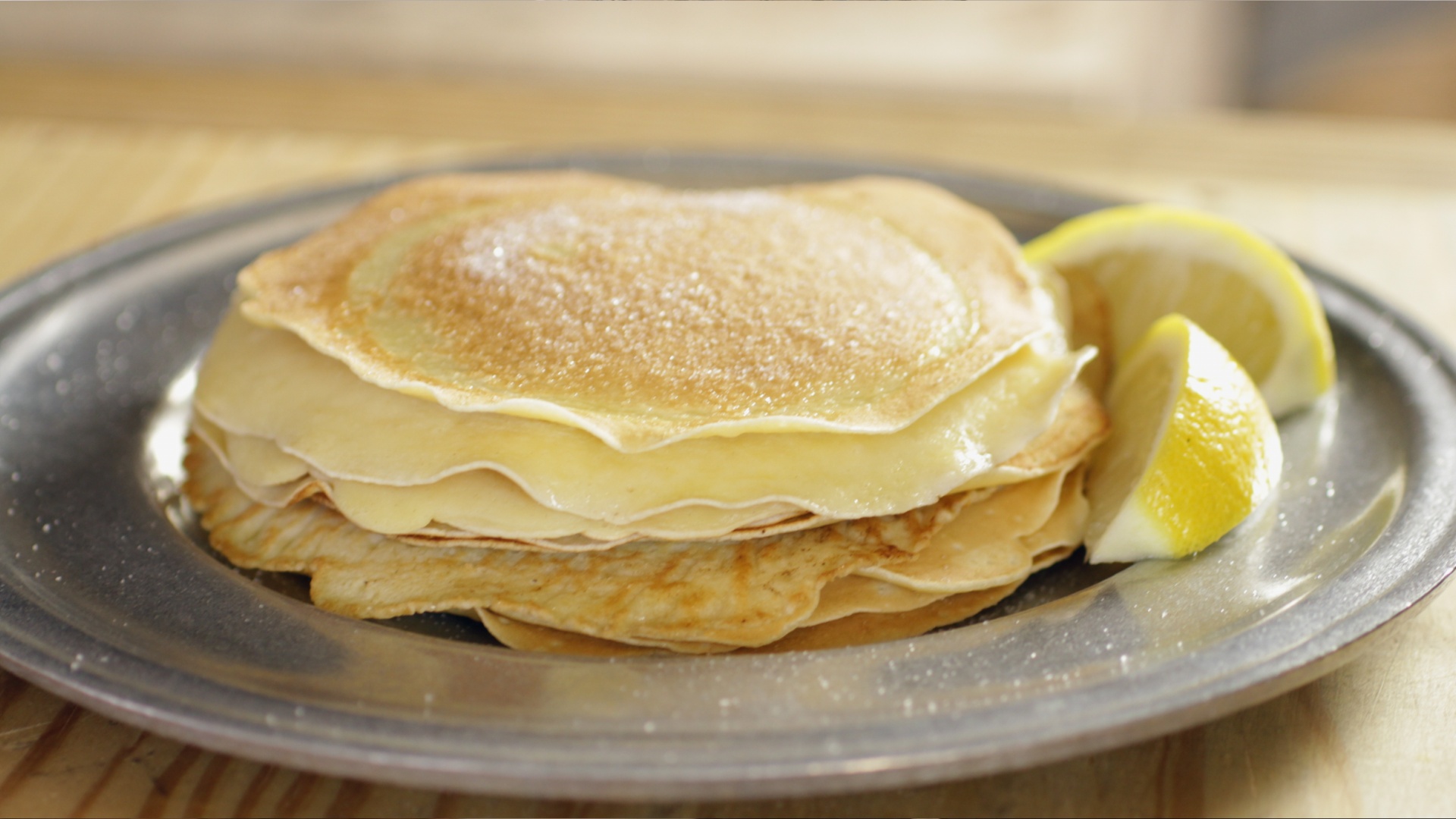
These pancakes were intended to be fried until brown and crispy. As you stack them, sprinkle a little sugar between each layer. To serve, fold them in half, top them with a little more sugar and some fresh lemon juice. An optional sauce can be made with a little sack (sherry wine), sugar, and melted butter.
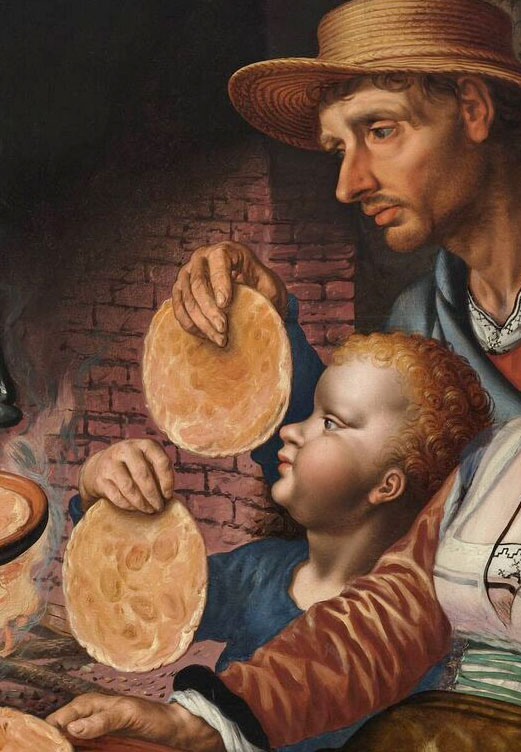
It’s pancake week on our picture reference blog, SiftingThePast.com, and I couldn’t help but notice how people were holding their pancakes in a couple of the paintings .
Notice, below, the man in the background holding his pancake as well as the excellent pancake flipping technique being demonstrated in the foreground:
While I look forward nearly every day to going to work, every now and again, I’ll look forward with greater anticipation to the drive home. I know of no job that is void of any stress of one sort or another. Adam’s curse, I suppose. It seems I need a little stress to remain focused and efficient.
In order to avoid bringing the stress home with me, however, I’ll imagine stripping off the various events of the day and leaving them along the roadside as I drive — much like a weary mechanic, or farmer, or factory worker might discard his grimy salt-stained clothes as he makes his way to the shower.
“I’ll pick up the mess tomorrow morning on the drive back.”
I’ll pull into the driveway and walk through the door, where I’ll be warmly greeted by the nearest of my two teenagers with something like, “HiDadhowwasyourdaywhat’sfordinner?”
Taped to the inside of one of my kitchen cabinet doors is a collection of tattered paper scraps with tried-n-true recipes scrawled in cryptic codes. When the pantry’s low, or I forgot to thaw the chicken, or I simply don’t want to resort to another trip through the drive-thru, I’ll fall back on my favorite recipe for pancakes. After all, pancakes aren’t just for breakfast.
Sure, there are a few who scoff at the idea of eating pancakes for dinner, but if we look beyond the confines of modern North Americanism, we’ll discover that I’m actually in good company. The elevation of the fluffy flapjack to the status of quintessential breakfast food is, for the most part, a recent development in worldview.
The word, “pancake,” according the Oxford Companion to Food, seems to have first appeared in the English vernacular in the 13th century, and it was used then in such a fashion to suggest it was a familiar term.
The Apicius, a 4th-century A.D. collection of Roman recipes, includes instructions for a griddle cake made with egg, milk, and flour, sweetened with honey and pepper. 5th-century B.C. Grecian poets sang of the “Tagenite,” a flatbread made of flour, honey, and milk curds; the name for this ancient Greek dish is derived from the word meaning “frying pan.”
Who knows where and when the pancake originated. One thing is certain however, today pancakes exist on menus around the globe. Wikipedia lists around 70 variations, some of which I can’t spell with this keyboard of mine, let alone pronounce without laughter in the distance.
A Quire of Paper
So it’s not unreasonable at all for me to imagine tattered “receipts” for pancakes pinned to the walls and cupboards of 18th century kitchens…both English and American. Pancake recipes are included in nearly every 18th century English cookbook. The few early American cookbooks also include them. Amelia Simmons’ 1796 cookbook “American Cookery,” for instance, includes recipes for “Indian Slapjacks” (a pancake using corn and wheat flours), yeast-based “Buckwheat cakes” (also included in Susannah Carter’s 1803 revised cookbook, “The Frugal Housewife“), and “Federal Pan Cakes” (using corn and rye flours). Mary Randolph’s 1824 cookbook “The Virginia Housewife” includes a recipe for the ultra-thin pancake, “A Quire of Paper” seen in earlier English cookbooks.
It’s William Ellis’s 1750 book, “The Country Housewife’s Family Companion” that gives a clear picture of how pancakes were enjoyed by gentry and commoners alike. For some, pancakes were dessert; for others, they were the entire meal. Ellis includes a range of pancake recipes from those made by the poor using water or ale instead of milk, to those that used such extravagant ingredients as cream, sack, and orange-flower water. Ellis also perpetuates to the long-standing debate over whether water is better to use than milk. He references Gervase Markham’s 1615 cookbook “The English Hus-Wife” which suggests that using milk or cream instead of water produces a much tougher pancake. Judging by the number of 18th century recipes for milk pancakes, however, it’s apparent that milk edged out water in the end.
Google the phrase “English Pancake Recipe” and you will find stacks of recipes that have remained relatively unchanged for hundreds of years. Commonly served with sugar and a squeeze of lemon (a Maria Rundell suggestion in her 1807 cookbook), pancakes were and still are associated with Lent. They are prepared on Shrove Tuesday (commonly called “Pancake Tuesday”) in anticipation of Ash Wednesday, when such luxury ingredients like cream begin their temporary Lenten prohibition. The thinner unleavened English pancake was also enjoyed in America until the use of chemical leavening agents took over in the late 1800s. The pancake recipe in the 1854 “The American Home Cook Book” is for an English-style pancake.
After comparing a number of 18th century pancake recipes, I was frustrated once again by the lack of precision in these old instructions — a sentiment shared by Karen Hess in her annotations of “Martha Washington’s Booke of Cookery.” But a little leeway is needed when interpreting and reproducing these old recipes. Hess had much to say about differences between such things as 18th century wheat flour and modern wheat flour that can dramatically affect outcomes. Consequently, the focus of our interpretation needs to be more on the viscosity of the pancake batter than the precise measure of ingredients.
Having said that mouthful, let’s get started with our recipe. I’ve written this delicious one down myself and taped it up next to my other favorite pancake recipe — just for a little variety.
18th Century Common Milk Pancakes
18th Century Common Milk Pancakes
Ingredients:
2 c All-Purpose Flour
1/2 t Ground Nutmeg
1/2 t salt
1 t Powdered Ginger
1 Egg
2 – 1-1/4 c Milk
Butter for frying
Directions:
Combine the dry ingredients. Add the egg and about half the milk. Stir this until the batter is well incorporated, albeit thick. continue to add additional milk, whisk well, until the batter is slightly thicker than heavy cream.
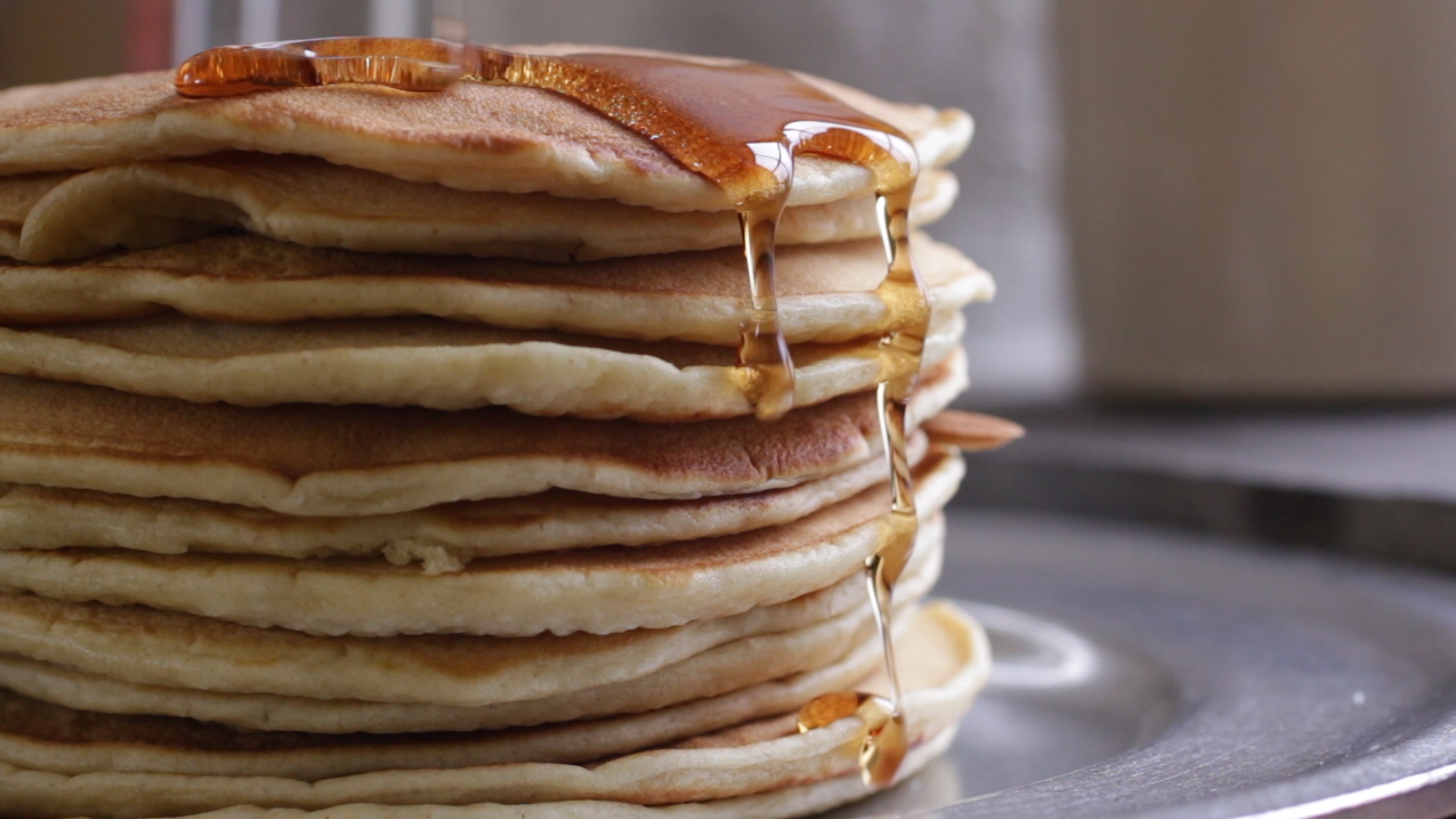
Heat a frying pan over medium heat and melt about 1/2 to 1 T of butter. (Some of the old recipes suggest coating the pan with clarified butter, then pouring any excess butter out before adding the batter.) Ladle in about 1/4 cup of the batter. Tilt the pan so to swirl the batter around to distribute it evenly. Cook for a minute or two until the pancake is golden brown on the bottom side. Flip and cook for about 30 seconds. Repeat.
Sprinkle a little sugar between each of the pancakes as you stack them. If you like, a little cinnamon can be mixed with the sugar as well.
Squeeze a little fresh lemon juice on the pancakes to serve.
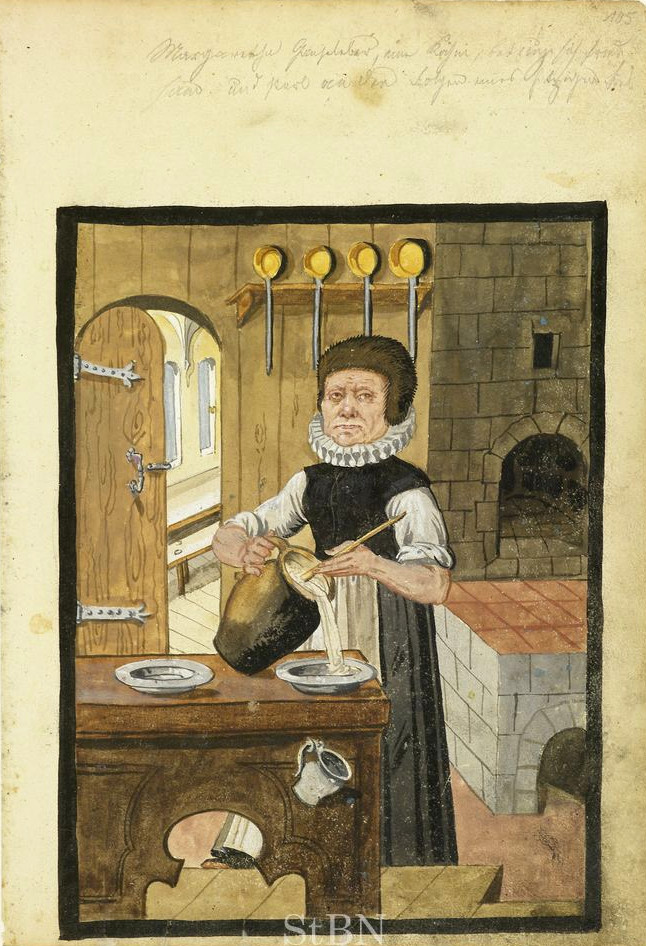
Many folks have expressed interest in the raised hearth and oven we use in our 18th century cooking video series. I have recently run into a couple of 16th and 17th century German images that show just such an arrangement.
16th Century Cook working with raised hearth and built in oven
17th Century kitchen with raised hearth and oven
These images are from a great resource “House of Mendel’s books” that has hundreds of paintings that depict different trades from the 15th through the 19th centuries. Pity that there is no complete english translation but very useful none the less.
Here at Jas. Townsend & Son, we’re presently researching, of all things, the history of pancakes. We noticed a broad range of various pancake recipes as we perused the numerous period cookbooks in preparation for our video series, but we routinely skipped over them for more adventurous fare. But the ubiquitous pancake has finally caught the attention of our easily enticed eyes, and as a result, you can fully expect future blog entries as well as videos on this historically important food item.
But pancakes are not the point of this post.
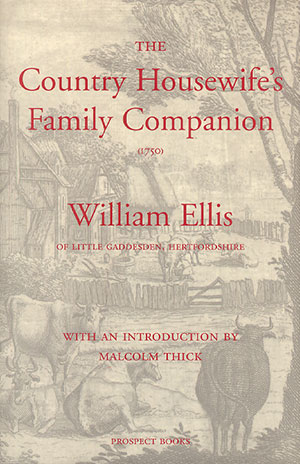
Nestled in this grand terrain of flapjack, fritter, and crepe recipes rises a mountain of a treatise on pancakes by William Ellis, in his book The Country Housewife’s Family Companion. Lacking the pedigree of most of his competing culinary counterparts, Ellis, who was a maven of anecdote, drew upon his skills in observation and storytelling to present a grand collection of conventional wisdom. The frontispiece of this 1752 work on country life and cooking admits the rather unconventional qualifications for an author of a cookbook with the line, “The whole [of this book is] founded on nearly 30 years of experience by W. Ellis, Farmer…”
The few remaining references on Ellis’s life suggest that he was a popular 18th-century author, albeit only briefly, on English agriculture. His collection of best practices in agricultural affairs was popular among English country gentlemen, yeomen, and farmers, that is, until some of his readers visited his farm hoping to observe his prescribed methods as well as their successful outcomes. Instead, what they reported was a farm in complete disarray, and consequently much of Ellis’s writing was eventually dismissed as being largely fabricated.
Let that serve as a caveat to our modern interpretations, but even so, let us also avoid being too hasty to throw out the curds with the whey. The fact is, The Country Housewife’s Family Companion still gives us a rare glimpse into the daily customs, challenges, and conditions of English country folk.
This book merits further study by those interested in 18th-century cooking, husbandry, and country living in general.
You can find a digital version of The Country Housewife’s Family Companion here, with a superglossary offered here.
Printed versions are advertised here by Prospect Books.
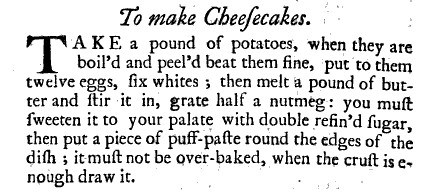
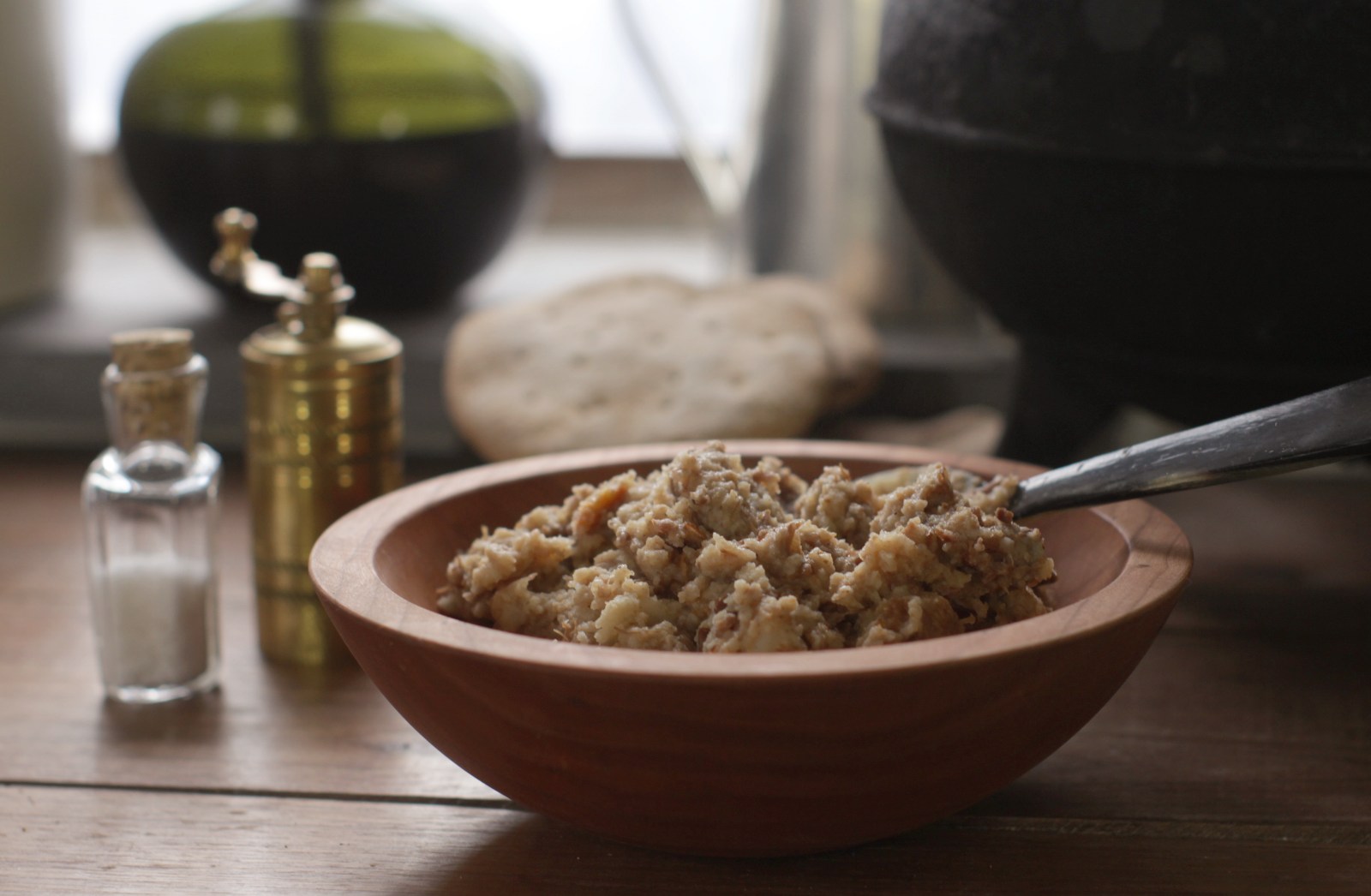
This “cheesecake” is easy and tasty. As you can see from the above recipe from Eliza Smiths 1739 “The Compleat Housewife”, it is basically a 1/3 potato, 1/3 egg and 1/3 butter tart with some sugar and nutmeg added for flavor.
Hints: Don’t skimp on the nutmeg. If it tastes too potato-y try baking it a little longer.
Lobscouse, made from boiled beef, vegetables, and ship’s bisket.
Ship’s bread or hard tack as it was known in the 19th century was a staple of the sailor’s diet in the 18th and 19th century and was also frequently issued to soldiers and used by other long distance travelers. A while back, we posted a video on how to make Ship’s Bisket.
One of the problems with these very hard biscuits is that they are somewhat difficult to eat. Therefore, some special dishes were made just to make use of this study food. One of these dishes is called lobscouse. Lobscouse is a bit of a generic term in the 18th century for a kind of simple stew made with meat, sea bread and vegetables if available.
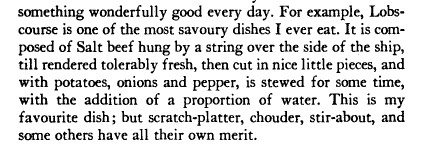
I have yet to find a single reference to lobscouse in any 18th century cookbooks, but there are many references to it in the 18th century literature and some hints as to what it would be like.
Grose’s 1785 – A Classical Dictionary of the Vulgar Tongue
Janet Schaw 1774 wrote in a “Journal of a Lady of Quality”
Traditionally this dish was made with salt beef or salt pork but since most people have greater access to fresh beef or pork we will include directions for that. If you are using salt beef or salt pork, your meat needs to be soaked in fresh water for a few hours to remove some of the salt.
Ingredients for Lobscouse:
2 Quarts Water
1 Pound Beef or Pork, coarsely chopped
1 Pound Potatoes, peeled and cubed
2 carrots, chopped
1 Pound Ship’s Biscuit, pounded
Directions:
First, chop up the beef in smallish chunks and brown it with pan drippings or a bit of cooking oil along with some chopped onion in your fry pan.
When the meat is browned, put it in a pot of water that has already been brought to a boil. If you start with salted meat, it doesn’t need to be browned, rather, it should be put directly into cold water that is then brought to a boil. The meat need to be lightly boiled for about an hour, after which you can add a couple of chopped potatoes and several chopped carrots.
Before you can use the ship’s bread, it needs to be broken into coarse chunks. Probably the easiest way to do this is to place it in a heavy cloth, pudding bag, or sack and beat it with a rolling pin, hammer, or the poll of a tomahawk. You could also use a marlin spike if you’re aboard ship. The chunks and crumbs can be added to the pot either with the vegetables, or if you want a bit more texture, add them 15 minutes after you’ve added the vegetables. You’ll need to allow this final mixture boil another 15 minutes before it’s ready to dish out.
In a previous post, I presented three common types of pastry crust used in the 18th century: the standing crust, the puff paste, and the short paste. These are fairly broad categories of crusts, and recipes for numerous variations for each have been published across the spectrum of 18th century cookbooks.
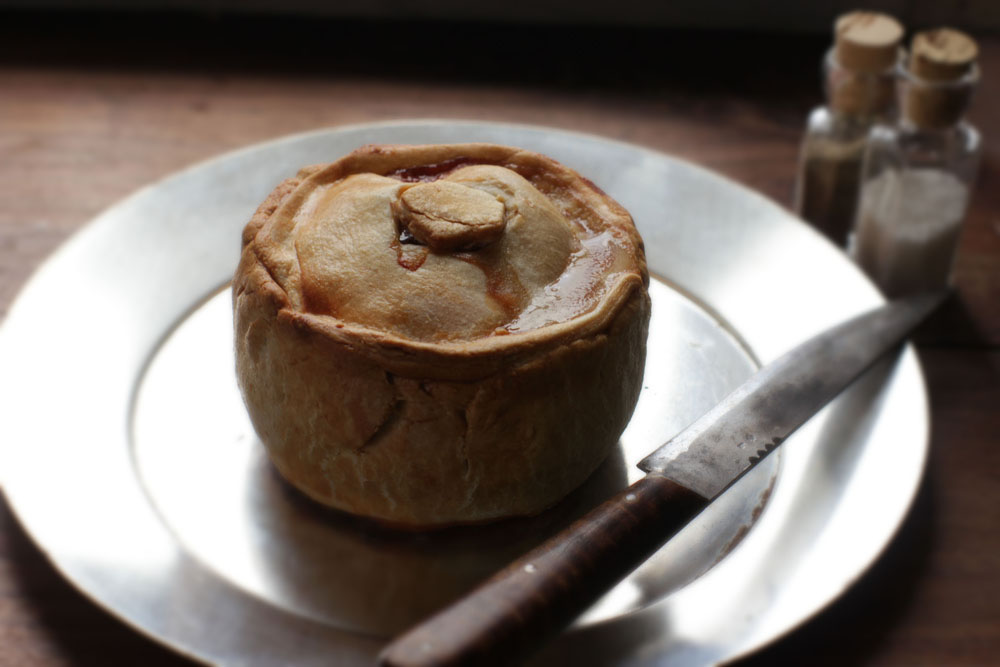
In the video above, Jon uses one variation of the standing crust to make a pork pie. It uses rendered suet for it’s fat ingredient.
Rundel’s recipe is for a larger standing pie. She recommends baking it in a slow oven because of the amount and density of the meat filling.
The final addition of a lear or a gelatin gravy (omitted in Rundel’s recipe) is based on the very common 18th century practice of adding gravies, i.e., broths, caudles (thickened broths), or gelatin gravies, to pies after they are baked.
Also contrary to Rundel’s recipe, we made our pies individual-serving size. There are many period cookbooks that suggest such meat pies can be made large or small. We’ve down-sized the recipe below to make two of these smaller versions.
Rundel’s recipe may be an ancestral version of the modern traditional Melton-Mowbray pies that are still very popular in portions of the U.K. today. Regardless of whether the Melton-mowbray pie can be traced specifically to this recipe or not, it is easy to conclude that the famed pies have roots which date back to at least the late 18th century.
Meat Pies were not constrained to standing crusts. Puff pastes or even short crusts can be used as well. Richard Briggs in his 1788 cookbook, “The English Art of Cookery,” when speaking of a wide variety of meat pies, suggests this:
The most fascinating aspect of our experiments with standing crusts was the differences we noticed in the effects that various types of fat had on the crust. Butter, lard, and muscle fat (what is commonly referred to in period books as “drippings”) do not set up solid at room temperature as suet does. Consequently, standing crusts made with these fats or any combination of them can be worked even when cold. Crusts made with suet, however, must be work when the dough is hot. The moment the dough cools down, any attempt to work it will cause it to crack.
By the way, if you’re concerned about using suet and whether it may contribute a meaty flavor to your crust, it is my experience that properly rendered suet imparts the least amount of flavor to a crust than any of the other fats.
So here are the ingredients we used, proportioned for two generously-portioned individual-serving pork pies (two people can easily be filled with one of these pies, however, you may find yourself somewhat unwilling to share). The video at the beginning of this post will explain the directions.
For the Crust:
2-1/2c flour
6T rendered suet
1/2c plus 2T water
1/2t salt
1 egg plus 1t Water, beaten, for egg wash
Be sure to watch the video below on how to form a small standing crust. We used a drinking glass for our a mold, however, pie dollies are available on line. If you choose to use rendered suet instead of the lard/butter combination we used in the video, be sure to form your crusts while the dough is hot. If the dough grows too cold to work, microwave the dough for a few seconds or cover the dough and set it near the fire.
For the Filling:
1 Pound Pork Shoulder, trimmed of fat and silver skin, and coarsely chopped
1/2 t Salt
1 t Black Pepper, ground
For the Lear (Gelatin Gravy)
Option 1:
1 Pig’s foot (have it quartered by your butcher)
enough water to cover
Option 2:
2 packets of Unflavored Gelatin
1-1/2 c water
While perusing several 18th century cookbooks, I’ve identified and included below a selection of recipes using suet. I chose these recipes because they seem to be fairly typical representations of food categories which commonly use suet: puddings, dumplings, pastry crusts, potted meats, cakes, sausages, forcemeats (stuffings), as well as fried and broiled foods. There are countless other recipes I could have chosen: beef olives, for instance, or forced leg of lamb — recipes that, judging by the number of cookbooks including them, were apparently very popular. I encourage you to try these!
This recipe for dumplings is from Sarah Martin’s 1795 book, “The New Experienced English Housekeeper.” These dumplings are to accompany boiled beef. Don’t worry about how big “the bottom of a plate” should be. Make them however big you feel dumplings should be.
– Pastry Crust –
I have vowed to myself to one day make a Yorkshire pie. Yorkshire pies were commonly served around Christmas and Epiphany, and were intended to serve large crowds. Be sure to read our blog post on Christmas pies. This recipe makes an enormous pie. When was the last time you made a pie crust using 24 pounds of flour? This clip is from John Farley’s 1783 book, “The London Art of Cookery.”
– Potted Meat –
Here’s one method of of using suet to keep beef for longer periods in pots. This recipe is from Mrs. Frazer’s 1791 book, “The Practice of Cookery, Pastry, and Confectionary.” Rendered suet can be used in place of butter to seal the jars. By “Oiling the butter” Frazer means to clarify it, skimming all dairy solids from it. If you use butter to seal the pot, be absolutely sure it is well salted. Unsalted butter will quickly spoil and become moldy.
– Cake –
Here’s a recipe for cake using suet from John Perkin’s 1797 book, “Every Woman her own Housekeeper.” Dried orange blossoms are available online. Reading between the lines on this recipe, I suspect it is meant to be understood by the reader that the suet is first to be rendered, then allowed to solidify, and then grated before adding it to the other ingredients. There is very little instruction given here.
This recipe is an exception to my comments above regarding my choice of recipes based on their representation of their food category. Most period cake recipes depend on mechanical leavening for their light and airy texture. This is accomplished by beating egg whites into chiffon, which is then carefully folded into the cake batter. This recipe, however, omits eggs altogether. I suspect it uses suet instead to create a heavier, yet spongy texture. If this is indeed the case, the suet would need to be added in grated form as opposed to melted, as a cursory reading might suggest.
– Sausage –
Here’s a simple, but amazingly delicious recipe for sausage from Maria Rundell’s 1807 book, “A New System of Domestic Cookery.” Similar recipes suggest that these can be made up into “finger-like” shapes and browned in butter.
– Forcemeat (Dressing) –
Here’s a recipe that uses suet. It’s for forcemeat, or dressing. It’s from Mary Johnson’s 1753 book, “Madam Johnson’s Present.” If rabbit isn’t your thing, a fowl of your choice will work as well. A couple notes of clarification: obviously, you can substitute ground spices for those pounded in a mortar, or you can use one of our spice mixes that accurately follow original 18th century mixed-spice recipes. Also, the ‘catchup” mentioned here is likely either walnut or mushroom ketchup. (Be sure to check out my previous post on 18th century ketchups.) If you don’t have 18th century ketchup, I suggest a spoonful of Worcestershire sauce instead — a close substitute.
– Frying –
Come late spring, I love to head down the hill with fishing pole in hand, hoping to stink up a frying pan with a few bluegill or a nice bass. You can bet I’ll be trying this recipe from Francis Collingwood’s 1792 book, “The Universal Cook.”
– Grilling & Broiling –
And finally, here’s a technique for using suet when grilling or broiling. This is from T. Williams’ 1797 book, “The Accomplished Housekeeper.” Beef steaks can be grilled in the same fashion.



















 Savoring the Past