When it comes to interpreting 18th century cookbooks, sometimes it pays to go with your instinct when it tells you a recipe may be inaccurate.
Take for instance this recipe from the book “The Universal Cook” by Francis Collingwood and John Woollams (1806):
I’m quite certain even the most robust palette would find a mincemeat pie made with eight ounces each of mace and nutmeg shockingly inedible.
Now, I don’t want to sound overly critical of all the hard work that Mr. Collingwood and Mr. Woollams put into their book. I don’t want to be another Ann Cook, for instance, who started her 1760 cookbook, “Professed Cookery” with a lovely poem followed by nearly 70 pages of scathing criticism of the work, “The Art of Cookery” by her culinary rival, Hannah Glasse. After all, I have made my share of mistakes in life and have even made a few mistakes on behalf of my closet friends. I’m sure the mistake here was a simple one: the word “pound” was innocently used in place of the word “ounce.”
But not all innocence is innocuous. Small amounts of nutmeg and it’s aril companion, mace, are just fine for human consumption (albeit, not so for pets, which is why you should never let your dog drink the leftover eggnog after the party). These are versatile spices, used in both sweet and savory dishes. But unfortunately for all of those inexperienced 18th century cooks who took the above recipe at face value, consuming large amounts of nutmeg can result in myristicin poisoning. Symptoms include convulsions, dehydration, nausea, palpitations, headaches, dizziness, dry mouth, blood-shot eyes, memory disturbances, visual distortions, hallucinations, and paranoia.
I knew when I read the recipe that a full pound of this spice combination had to be erroneous. So I cross-referenced this recipe to others found in some of my favorite 18th century cookbooks. It was then I began to smell something a little more sinister (at least by modern standards) wafting from the kitchen: plagiarism!
The first edition of “The Universal Cook” was published in 1792 — that’s nine years following the original publication of John Farley’s book, “The London Art of Cookery.” Compare Mr. Farley’s mincemeat recipe to the aforementioned version:
Plagiarism was apparently pretty common in the 18th century, that is, if the considerable number of offenses I’ve noticed in the old cookbooks is any indication of that. But in this case, I wonder if it carried dire consequences. Kind of a culinary karma.
The moral of this story is to read twice, bake once — similar to the ol’ carpenter’s mantra, “measure twice, cut once.” Calmly put the whisk down if your instinct tells you something smells fishy. If a recipe calls for eight ounces each of nutmeg and mace, you may want to consider cross referencing the recipe.
And for a broader application of this principle, in the reenactor’s or historical foodie’s endeavor to be historically accurate, one might want to be sure that what he or she is meticulously replicating was accurate in the first place.
The standing crust was probably the oldest form of pastry in English cooking. While it really wasn’t intended to be consumed, it was an ingenious culinary invention designed to serve as a baking dish, a storage dish, and a serving dish. To read more on the standing crust, refer to our post, “The Crust of Time.”
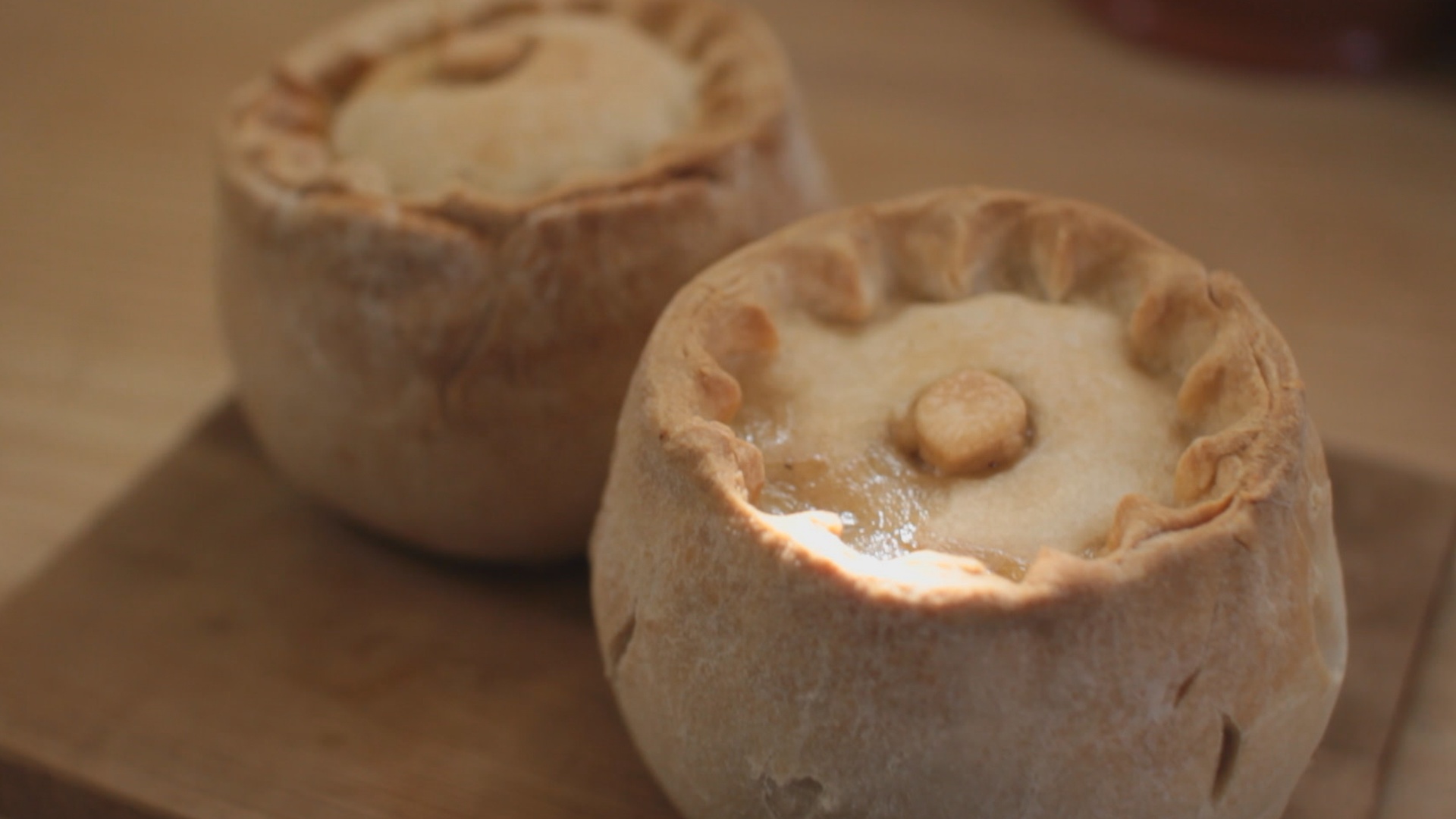
Here is a recipe for a standing crust, adapted from a number of 18th century recipes. It’s proportions are suitable for two individual-serving standing crusts. A demonstration of how to make this crust can be seen in the video below. At the end of this post, we’ve also included a recipe for pork pies from Maria Rundell’s 1807 book cookbook, “A New System of Domestic Cookery.”
A Recipe for a Standing Paste
Ingredients:
2-1/2 cups All-Purpose Flour
6 Tablespoons Butter, Lard, or a combination of both
1/2 cup plus 2 Tablespoons Water
1/2 teaspoon Salt
1 Egg, beaten, for egg wash
Directions:
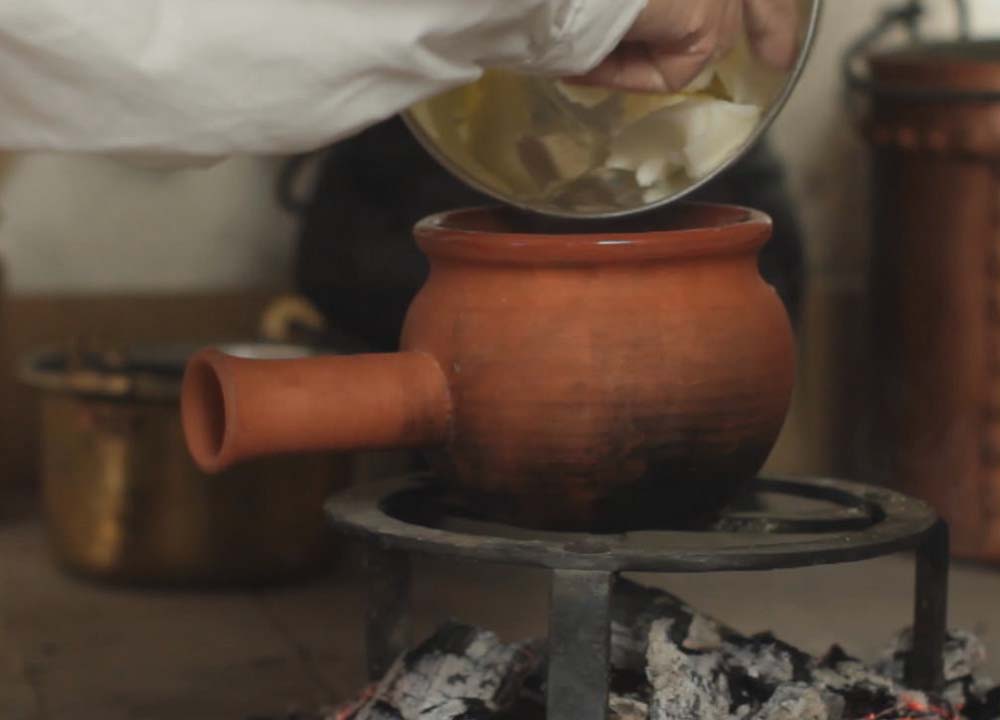
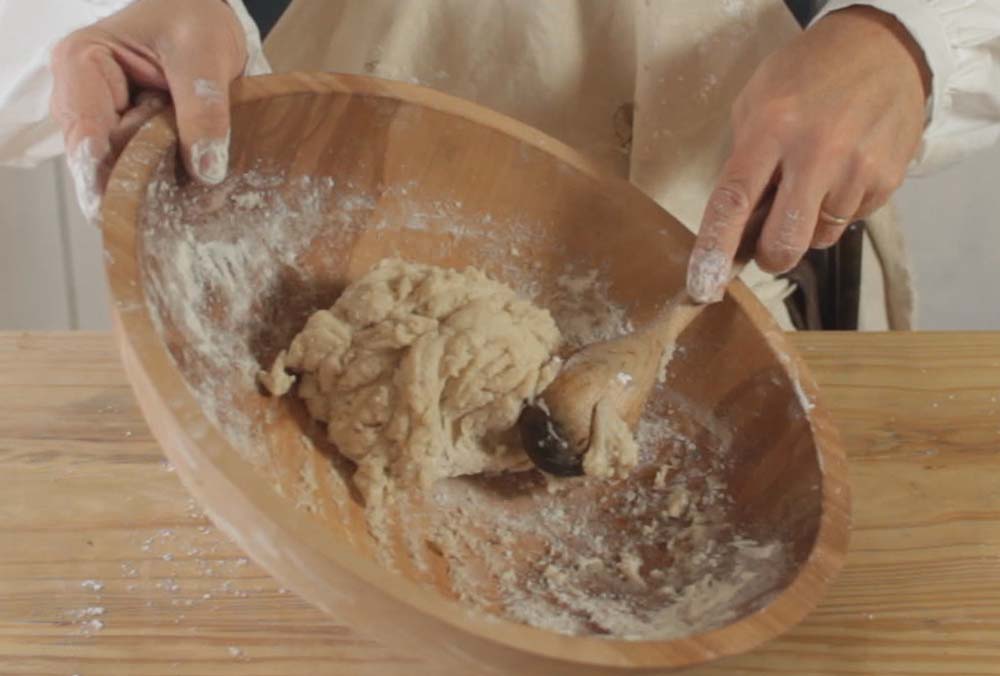
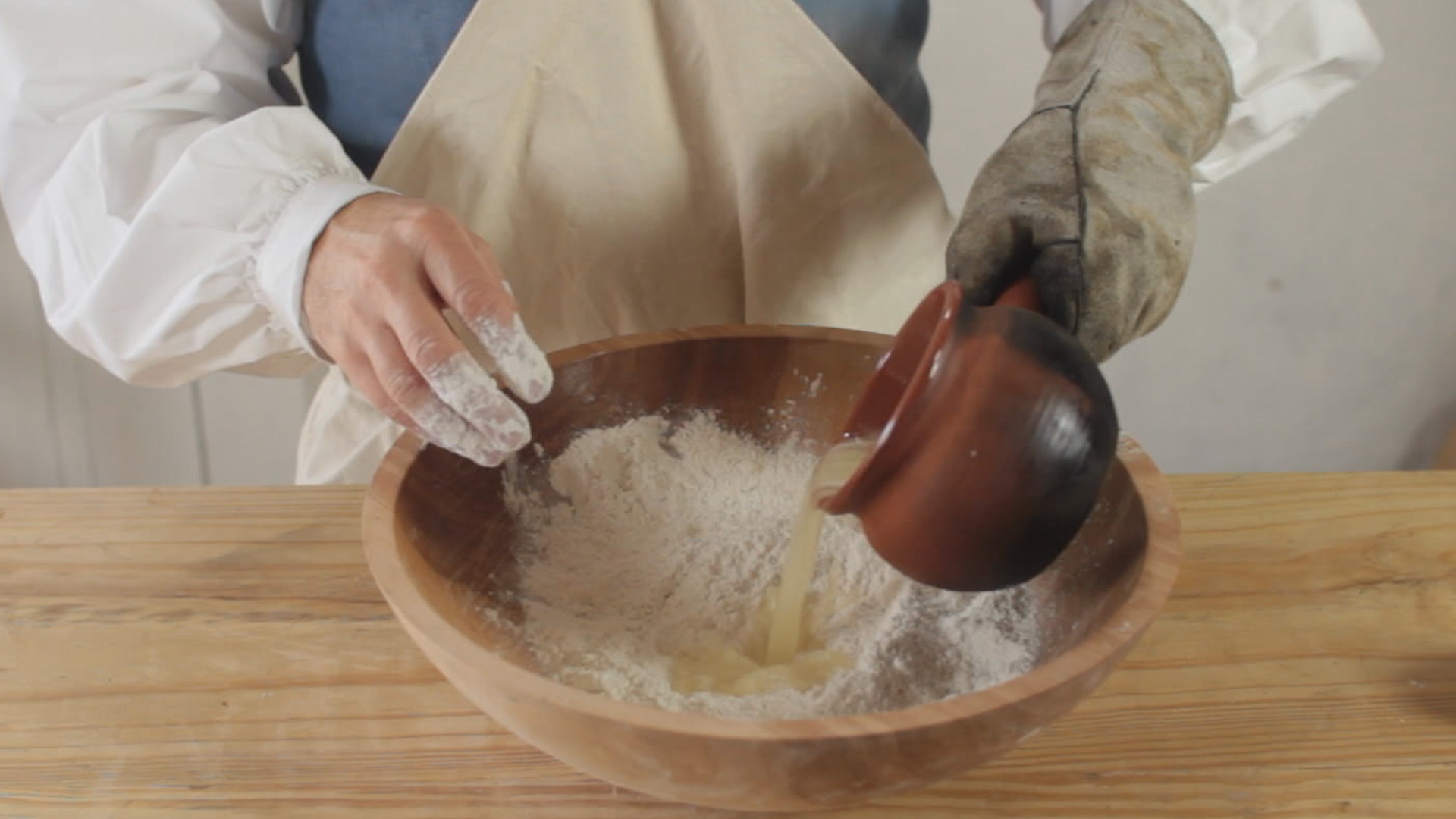
Bring the water, salt, and lard or butter to a boil and then add the mixture to the flour. Bring the dough together and knead for about 10 minutes. The texture will resemble that of “Play-Doh.”
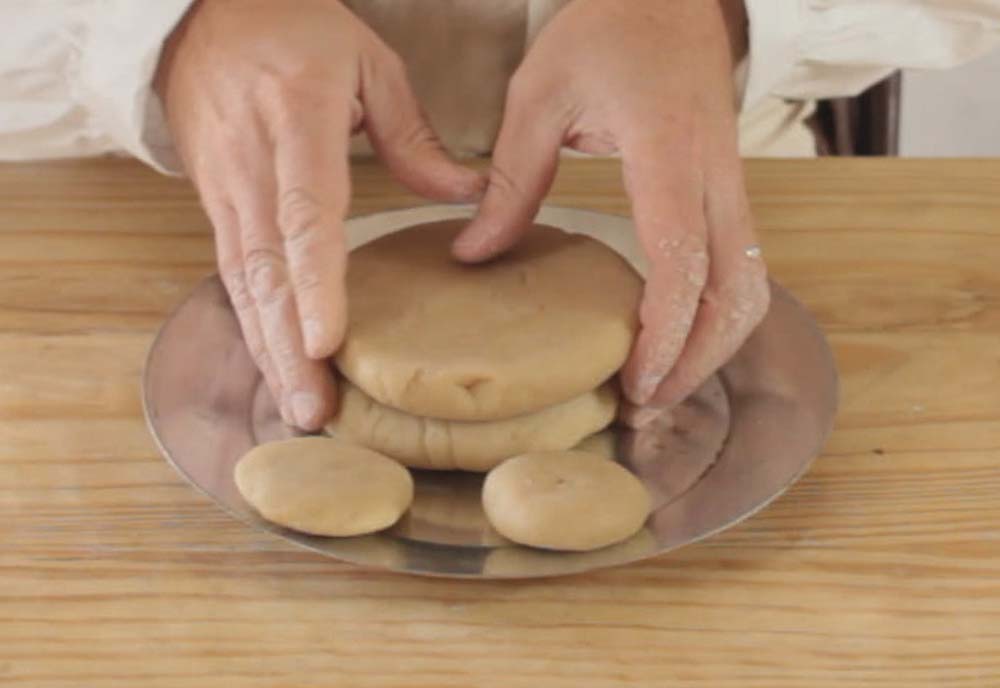
Divide your dough into 2 equal portions, then remove a lump from each portion, about the size of a walnut (for the lids).
Roll your dough portions into balls and flatten into disks about 1″
thick, then wrap them in a damp cloth or plastic wrap, and allow to
cool and rest for at least 3 – 4 hours or even overnight.
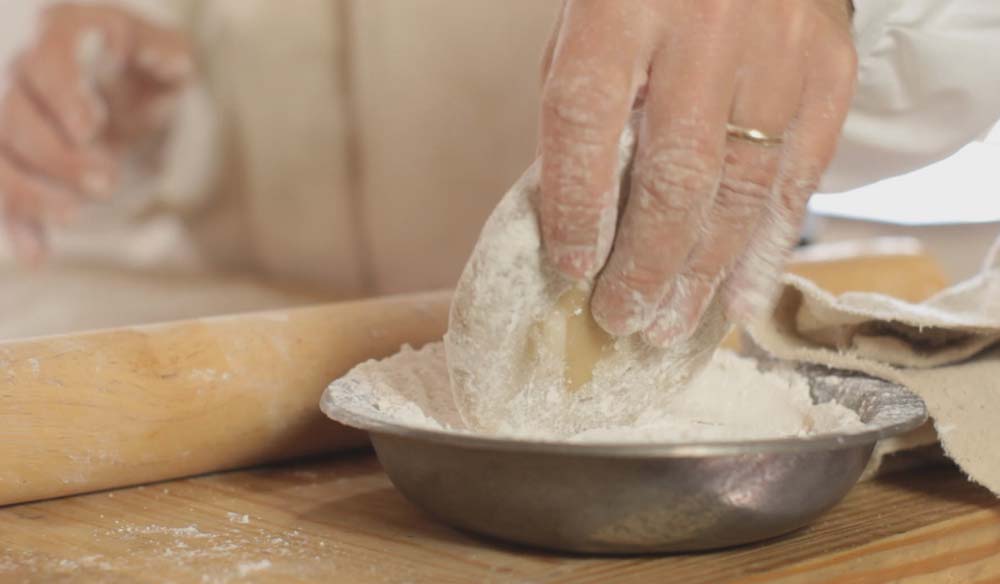
When forming the crust, begin by dredging each portion of dough
in flour. Roll out the 2 smaller pieces to about 1/8″ thick. These
are your lids.
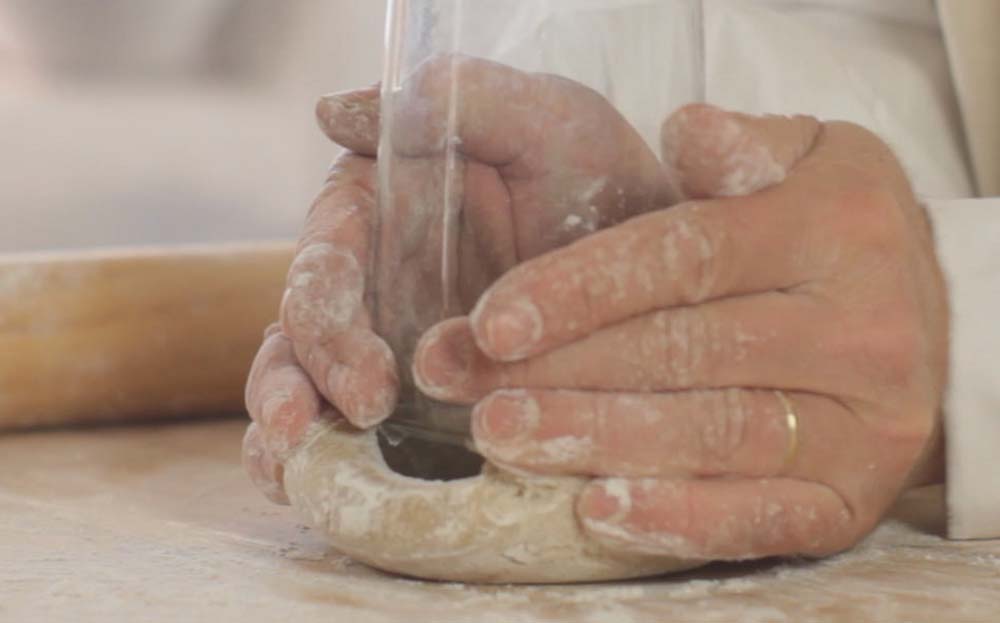
Take a bottle, jar, or drinking glass about 2-1/2″ to 3″ in diameter and place it in the middle of each of the larger dough disks and press down. Be careful to avoid pressing all the way through the dough. The bottom should be no less than 1/8″ thick. We are uncertain what tool was used in the 18th century to do this step. Cooks in modern Melton-Mowbray use a wooden mallet-like tool to form the crust, but while we know the crust itself is a carry-over from the 18th century, we don’t know if the tool is as well. Larger standing crusts were sometimes constructed in pieces. We will demonstrate that technique in a subsequent post.
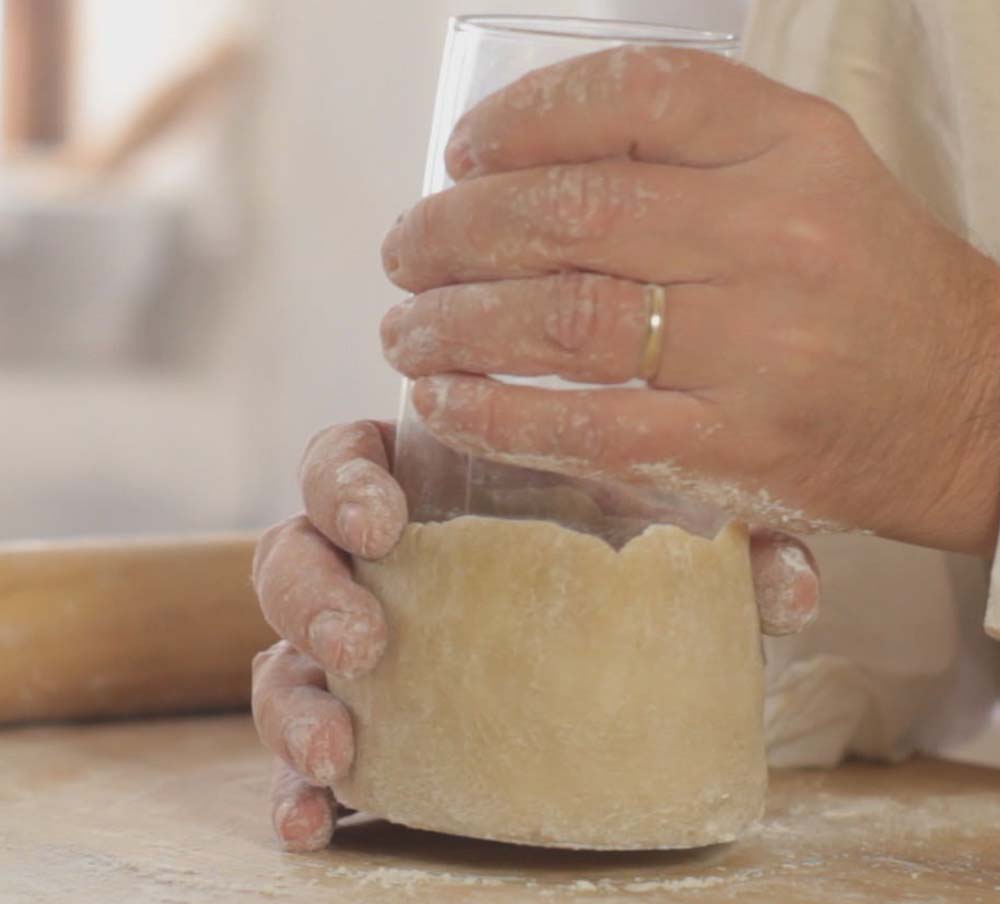
With the palms of your hands, squeeze and pull the dough up the sides of the form, rotating the form and pressing the dough as you work. The walls should be about 2-1/2″ to 3″ tall, and 1/4″ thick.
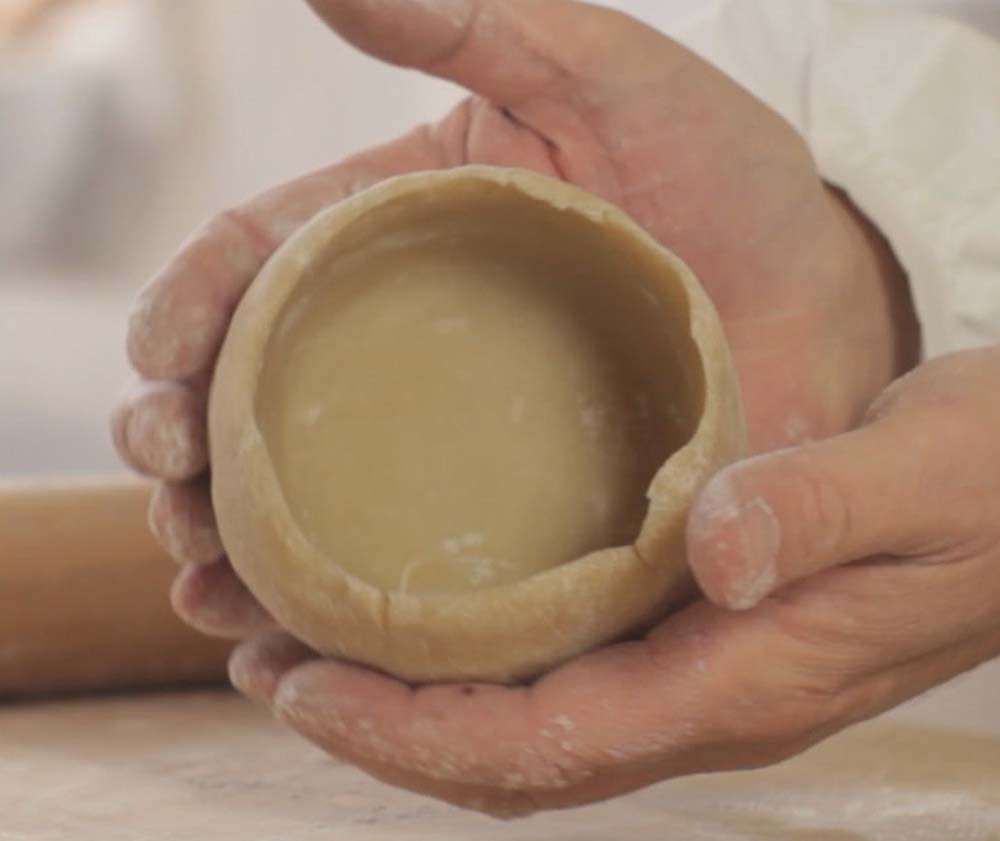
Gently remove your form. Adjust the wall thickness by gently squeezing the dough. Any cracks in the dough can be repaired by brushing a little water in between the two halves of the crack and squeezing them together.
“An Excellent Pork Pie, to Eat Cold” adapted from Maria Rundell’s book, “A New System of Domestic Cookery” (1804)
Ingredients:
1 lb. Pork Shoulder, pounded thin and coarsely chopped
2 Tablespoons Fine Bread Crumbs (optional)
1/2 teaspoon each, Salt and Pepper
1 T. Butter
1 egg, beaten for egg wash
1 Pig’s foot (or 1 package of unflavored gelatin)
Directions:
Combine the pork, bread crumbs, salt, and pepper. Divide the pork mixture evenly, and gently press into each standing crust, eliminating any possible trapped air. Top with a dab of butter.
Brush egg wash on the inside of the standing crust’s rim, and place the lid over the pork. Seal the crust by crimping the lid to the walls.
Poke or cut a vent hole into each lid. Brush the lid with egg wash, avoiding the crimped edges lest they burn. Bake in a medium oven, 350° (F), for 1 hour. Allow to cool.
While the pies are cooling, cover the pig’s foot with water and boil for one hour. Strain off the broth and pour into the vent hole of each pie. This broth is called a “lear.” While the use of a lear is not found in Rundell’s recipe, they were often used with standing-crust dishes, and are still used today in the traditional British pork pie.
Proper seasoning can make all the difference between a bland chunk of meat and a course fit for royalty. We decided to dig through a collection of 18th and early 19th century cookbooks to see which spices were mentioned. We also took one of the more recognized books and looked at the frequency by which the spices appear in the recipes.
It’s seems to me to be a fairly safe and logical conclusion that the frequency by which particular spices, herbs, and seasonings were mentioned may lend insight into which were more popular. Granted, I can’t be too dogmatic in my conclusions. First, my sample is small. Second, taste preferences in the 18th century varied regionally and culturally just as they do today. So I wouldn’t attempt to apply my conclusions to every 18th century English-speaking cook, but this exercise seems to be an interesting starting point toward understanding preferences of the day. This is intended to be one snap shot of perhaps many, and hopefully helpful in a general sense for the interested reenactor or historical foodie who, perhaps, wishes to put together a spice kit or stock a spice box.
Salt — Sure, salt is a given as far as seasonings go. But if you’ve ever run across in the old recipes the terms “bay salt,” “sea salt,” “salt-petre,” etc, and wondered what specifically was being referenced, a good explanation can be found in Mason’s book:
I would not be at all surprised if I missed a few, but it’s pretty safe to say that this includes most of the spices found in the best-supplied English spice cabinets.
The Frequency by which Seasonings were Mentioned:
We took Moxon’s book and analyzed it for usage frequency. Of course, Salt is the most commonly included ingredient, mentioned nearly 300 times. Second was lemon peel or zest — mentioned 198 times. Then there is pepper with 158 mentions. Then nutmeg with 120, followed close behind by its aril companion, mace, with 110. Beyond that, the numbers drop off: parsley, 58 mentions; cinnamon, 30; ginger, 27; and cloves, 15.
Other Cryptic Seasonings:
We can’t overlook the phrase “sweet herbs,” as it is mentioned in nearly every period cookbook. The term remains more of a suggestion than a prescription of specific herbs. In nearly every case, “sweet herbs” referred to a bundle of fresh herbs — typically aromatics. I did find two specific recommendations: one for a combination of thyme, parsley, sweet marjoram, and savory; the other for sage, sweet marjoram, thyme, and mint. Marjoram and thyme, given all the honorable mentions in other recipes, seem to be the most typical components to these “sweet herb” bundles.
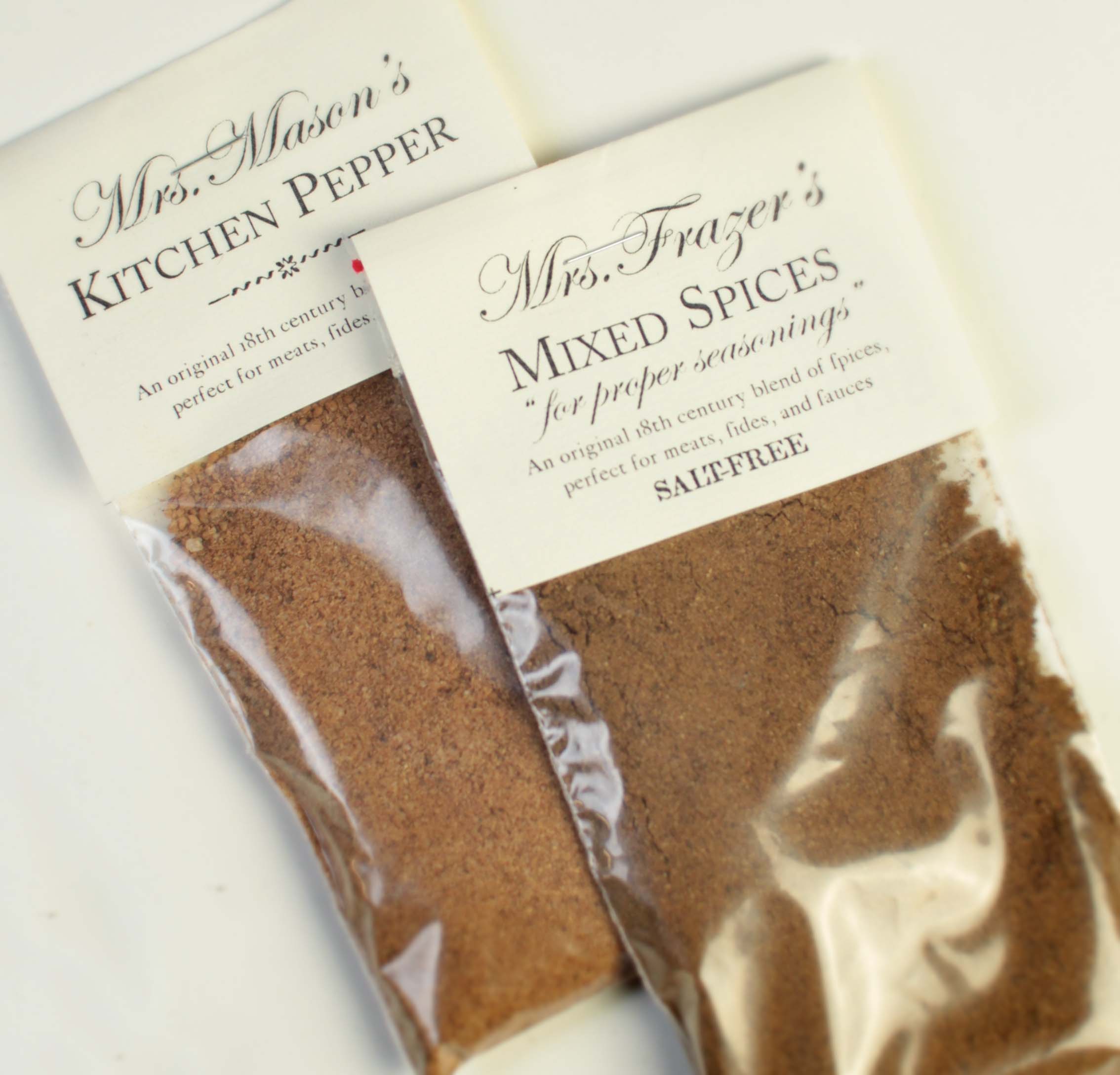
“Kitchen Pepper” is mentioned in Mason’s book, as is the phrase “Mixed Spices” in Mrs. Frazer’s 1795 book, “The Practice of Cookery.” These were spice blends which used some of the more common seasonings. Recipes are found in the respective books. Frazer’s blend includes allspice, pepper, nutmeg, and clove, while Mason’s blend primarily includes salt, pepper, ginger, and cinnamon.
Kitchen Pepper and Mixed Spices
We’ve reproduced these spice blends and made them available at Jas. Townsend & Son. We also carry a number of bottles, pots, and cans perfect for storing your favorite seasonings.
While many foods (and people’s taste preferences for them) have changed dramatically over years of culinary evolution, some remain unaltered from their ancestral origins. Take pie crusts, for instance: any trustworthy modern recipe likely calls for flour, cold butter and/or some other form of fat, a little salt, and just enough water to hold it together. One recipe may differ from another in terms of proportions, but interestingly, the basic recipe, as well as many if not most of the variations, can be found in cookbooks published a couple of hundred years ago.
According to the “All English Cookery Books” by Arnold Whitaker Oxford, there were nearly 120 cookbooks published during the 18th century. A remarkable number of them are available on line either in free electronic format, or in print-on-demand copies. I maintain an electronic bookshelf on Google Books that contains over forty 18th and early 19th century cookbooks. I am repeatedly drawn into their pages, conducting word searches, and comparing recipes to their contemporary and modern counterparts. I guess you can call me a food nerd. Discovering a connection between my dinner table and palates of centuries ago can be the highlight of my day.
I’ve been recently researching pastry crusts or “pastes” as they were called in the 18th century, in preparation for a new video series in 18th Century cookery. After reading through countless recipes and comparing ingredients and procedures, it became apparent that, while variations existed, period pastry crusts can be divided into three basic categories: standing pastes, puff pastes, and short pastes.
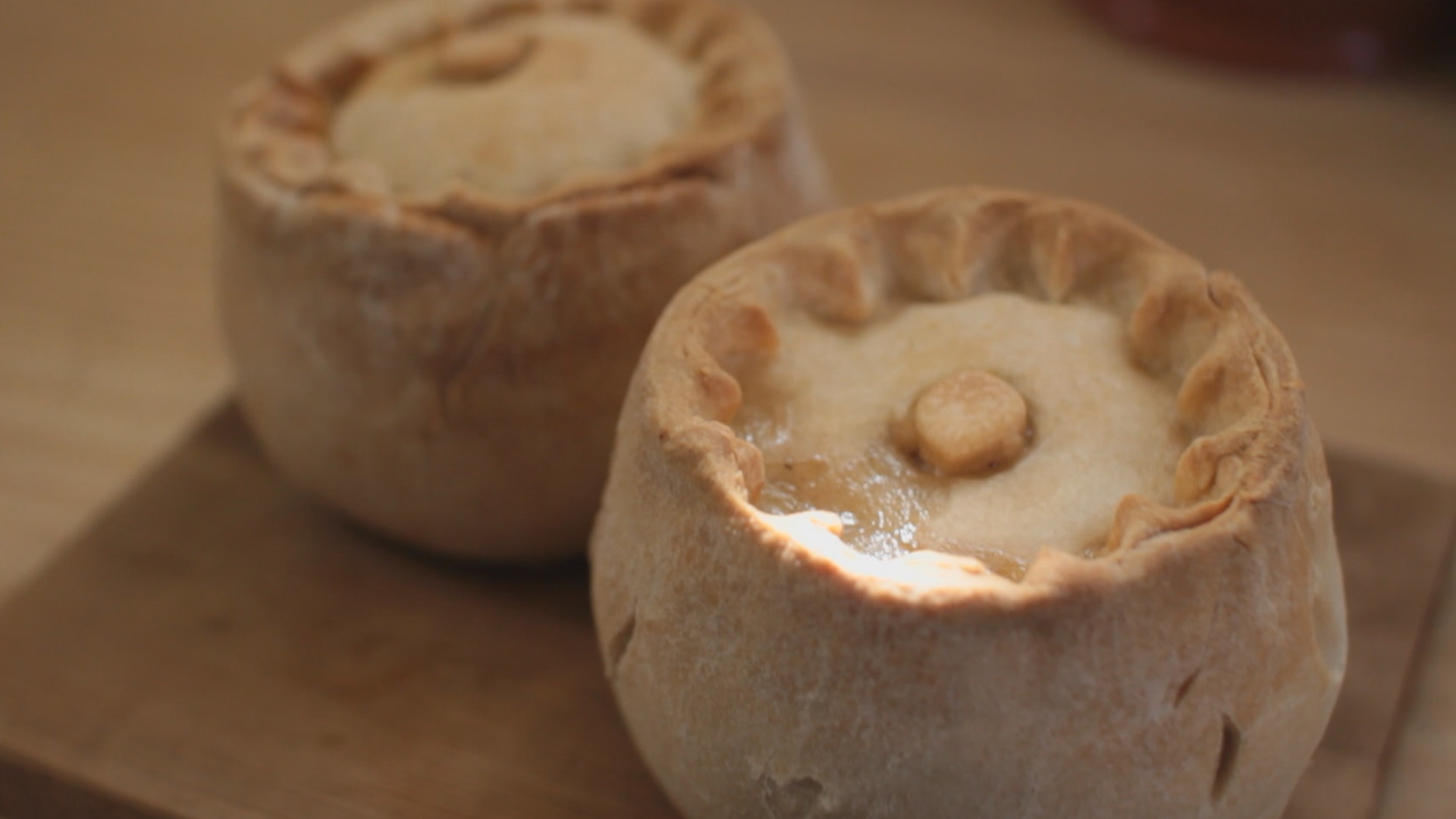
Modern American foodies are likely most familiar with the latter two. One can usually find convenient ready-to-use puff pastry and pie crusts (short pastes) in the frozen food section at the local grocery store. Most people on this side of the pond are less familiar with standing pastes, but ask our friends in Great Britain, and they will likely hand you a Melton-Mowbray Pork Pie.
18th century style pork pies with their free-form standing pastes
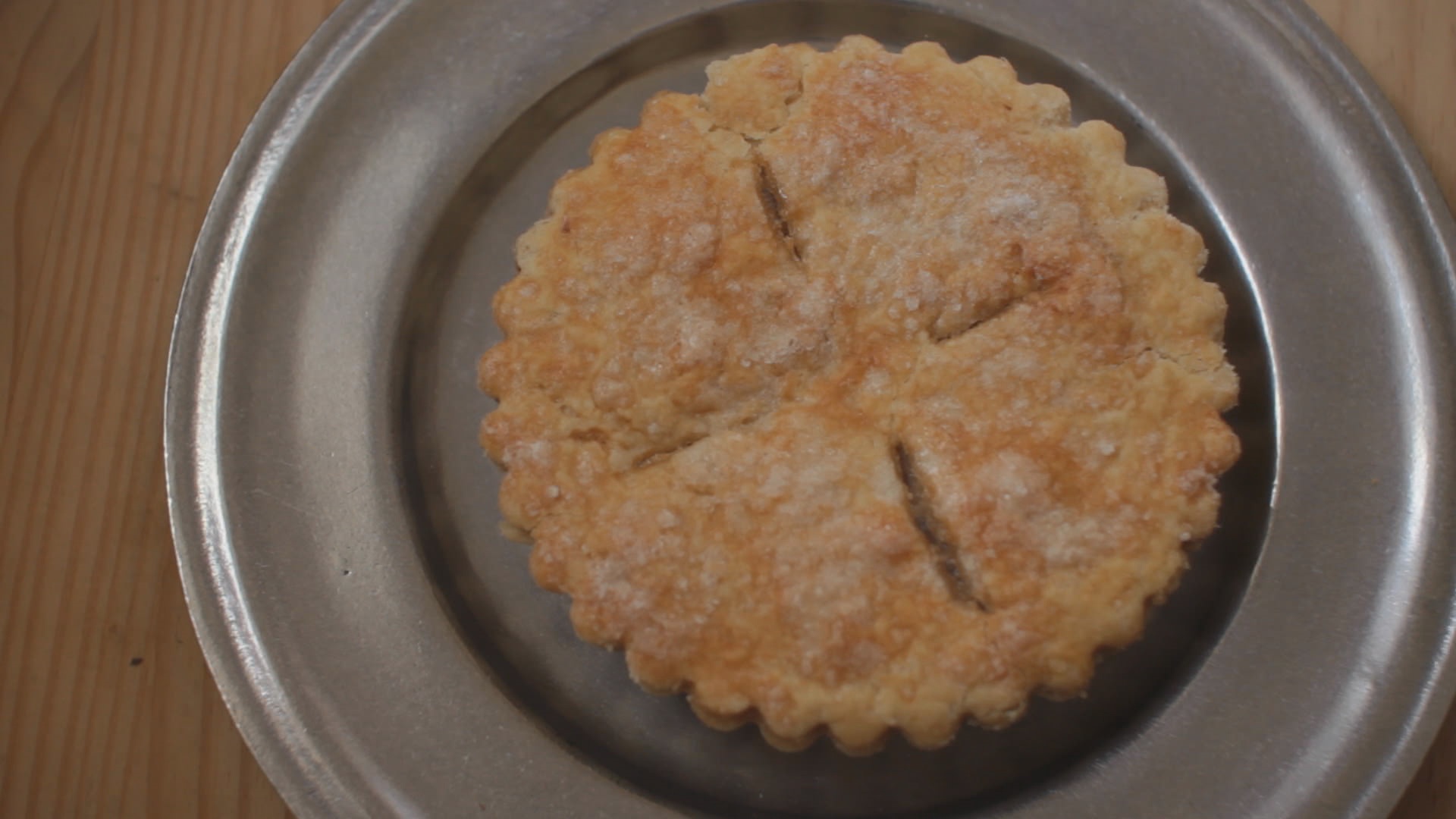
As alluded to earlier, short pastes are the pastry used to make the flaky crust in good ol’ apple pie. While one could say that short pastes are the latest innovation in pastries, fact is, they’ve still been around since the mid to late 1700’s. Period cookbooks recommend their use in fruit tarts and pies.
A pear tart made with an 18th century short paste crust
Puff pastes were most often assigned to savory dishes, though an occasional recipe suggested their use as top crusts for fruit pies. A pie pan or baking dish could be lined with puff paste prior to filling the dish with meat or vegetables. A top crust of puff paste was often added before the dish was baked. Some period recipes suggested putting the dish’s ingredients directly into the pan and then topping it with a puff paste.
An 18th century beef pasty using an authentic puff paste.
Puff pastes could also be folded into free-form pasties (pronounced PAST-eez). Original pasties were nearly always made with venison, suggesting, considering the scarcity of venison, they were intended for the aristocracy. Beef and mutton pasty recipes began appearing in the mid to late 18th century. They were eventually popularized as mobile meals for the working class. Culinary descendants of the original pasty exist in numerous cultural and regional forms throughout the United States, Great Britain, and around the world.
Both the short paste and the puff paste find their flaky success in the chilled temperature of their ingredients. The colder your butter, the better — an excellent rule to live by. While some differences in ingredients exist between these two types of pastries, the biggest difference exists in how the doughs are constructed.
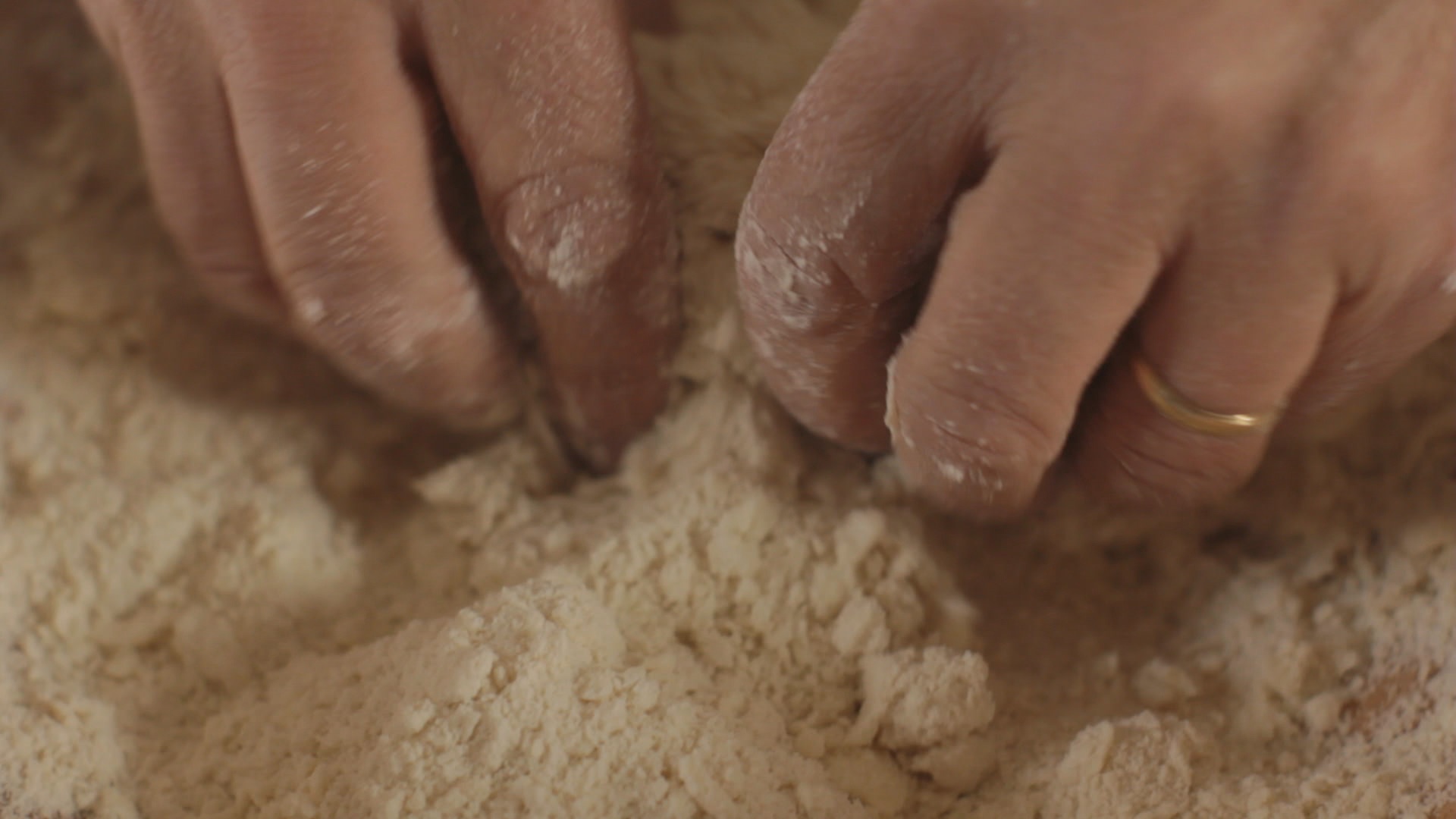
Rubbing butter into the flour
In short pastes, whether you are using butter, lard, or modern-day shortening, the fat is evenly distributed throughout the dough by either cutting or rubbing it in. The result, if done properly and prior to adding water, is a dry mealy flour that resembles corn flour. Moisture is then added to bind the dough together.
Puff paste being rolled out a final time after layers of butter and dough have been rolled and folded upon itself several times.
In puff pastes, the butter is laid between layers of dough. This layered dough is then folded upon itself, rolled out and folded again. This process is repeated a number of times, increasing the number of layers while making each layer of dough and butter thinner with each rolling out. The fine layering of butter and dough, if done properly, remains intact even after baking.
Adding boiling water and melted butter and lard to flour to make dough for a standing crust
In contrast to short pastes and puff pastes, standing pastes go in the opposite direction on the temperature scale. Ingredients are relatively the same, but the fat is melted in boiling water. The resultant dough has a similar texture to “Play-do.” It can be rolled out into sheets, allowed to cool, and then constructed into large free-standing crusts, or it can be pressed and manipulated into individual-size cups.
A cup made of standing paste awaiting a pork filling
Standing pastes are the oldest form of pastry crusts, dating back several hundreds of years. They were also called “coffins,” a word derived from the Old French term meaning “basket.” Frequently, standing crusts were large and ornate, exhibiting elaborate decorations.
Standing crusts — especially earlier forms which used only butter, were seldom eaten with their contents. They were too hard and often over-baked. Their intended purpose was to serve as a baking and serving dish. When a standing crust dish was brought to the table, the top crust was broken, the contents dished out, and the crust was either discarded, or taken back to the kitchen to be used at a later time as a thickening agent in other dishes.
Once a dish was baked in a standing crust, it could also be drained of it’s juices through a hole in the top the crust, and those juices would be replaced with melted butter or rendered mutton fat in order to seal the dish’s contents from the open air. The dish could then be stored in the larder for days or even weeks, and brought out to be reheated and served at a later date. The dish would be reheated, the fat poured off, and a lear or cullis of gelatinous broth added back through the hole in the top crust to replace moisture in the baked meat.
Modern British pork pies are still topped off with a lear before being allowed to cool prior to serving.
In upcoming posts, we’ll share authentic 18th century recipes for a standing paste, a puff paste, and a short paste. We will also post subsequent recipes for dishes that use these different types of crusts (e.g., beef pasties, pork pies, and pear tarts, just to name a few). Stay tuned to our website and YouTube channel for accompanying videos as well!
It can be hard at times to fathom just exactly what and what was not commonly available to folks in the North American colonies during the 18th century, but we do have some written accounts that can help. Here is a 1732 Boston newspaper advertisement that gives a bit of insight.
John Merrett, grocer. At the Three Sugar Loaves and Cannister near the Town-House sells: cocoa, chocolate, tea borea and green, coffee raw and roasted, all sorts of loaf sugar, powder and muscavado sugar, sugar-candy brown and white, candy’d citron, pepper, pimienta or alspice, white pepper, red pepper, cinnamon, clove, mace, nutmegs, ginger race and powder, raisins, currants, almonds sweet and bitter, prunes, figgs, rice, ground rice, pearl barley, sago, starch, hair-powder, powder blue, indigo, annis, corriander and carraway seeds, saltpetre, brimstone, flower of brimstone, all sorts of snuff, allum, rozin, beeswax, tamarines, castile soap, fine florence oyl, vinegar, capers, olives, anchovies, and fine English pickled wallnuts, icing-glass, hartshorn shavings and burnt gums ” …
O.k., so it may be an absurd question. The answer, however, is probably…but it may not be what you think.
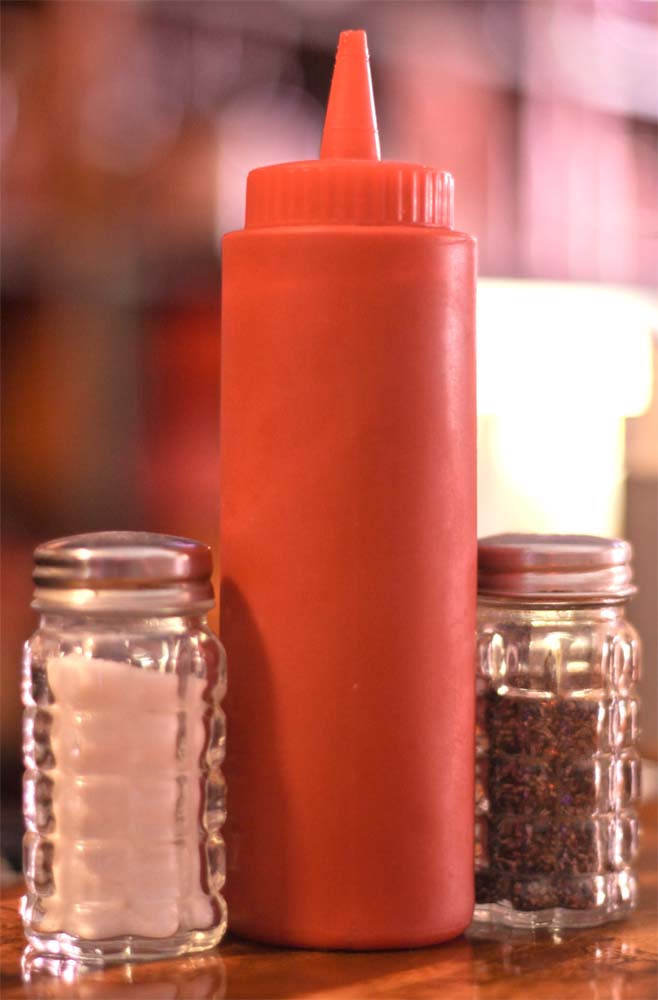
When I hear the word “KETCHUP,” the tangy tomato condiment immediately blots across the canvas my mind like a crimson Rorschach test. Ketchup is a necessary component of the backyard cookout. It’s the not-so-secret ingredient to many a blue-ribbon meatloafs. There’s a bottle of it sitting on the tables of most every diner, separating the salt and pepper shakers like misbehaving children.
But when you’re in Chicago, don’t ask for ketchup on your hot dog, or you’ll be branded a tourist. Um…the fanny pack may give you away too.
One of my all-time favorite Sunday-morning comics was by the master cartoonist, Gary Larsen. It featured a committee of ruminating vultures huddling over their rather ripe roadkill repast, while two of them reminisce the virtues of…(you remember this one too?)…ketchup.
Believe it or not, ketchup has been around for hundreds of years; that’s just about as long as the debate that has raged over whether the word is spelled “C-A-T-C-H-U-P,” C-A-T-S-I-P,” or “K-E-T-C-H-U-P.” The Oxford English Dictionary declares the winner: “Ketchup” is apparently the more commonly used of the three, so I’ll stick with that name for now.
But wait, I thought people long ago believed tomatoes were poisonous!
Many did, and for good reason. The tomato belongs to the nightshade family. And with the tag “nightshade,” the tomato is looking pretty evil. Other people — some apparently with a death wish, knew better.
It is believed that the great Spanish explorer, Hernan Cortes, may have been the first to introduce the “love apple” to Europe upon his return from South America. By the early 1500s, tomatoes became a staple in Spanish and Italian diets. By 1600, many British cooks decided it was time for the Spaniards and Italians to share in the fun. By the mid-18th century, tomatoes were fairly common English fare, typically used in soups and as garnishes or sauces for meats.
In the book Every Man His Own Gardener, by John Abercrombie and Thomas Mawe, 1767, it reads, “[Tomatoes] in some families, are much used in soups, and are also often used to pickle, both when they are green, and when they are ripe.”
There are numerous references and recipes for sauces made from tomatoes. Some of these recipes included garlic and spices, as well as vinegar — typical ingredients in modern-day tomato ketchup. Here’s a recipe from the Culina famulatrix medicinæ: or, Receipts in modern cookery, by Alexander Hunter, published in 1810:
Who knows? There’s much debate over the origin of this word. Some say it’s a variant of a Chinese word for fish sauce. Others say it is a Malay word for the same.
We know from references and recipes that by the mid 1700s, “Ketchup” was a culinary term spoken frequently in English kitchens. The condiment, however, associated with it was not a tomato sauce, but rather a flavorful concoction, sometimes fermented, sometimes not, based on either anchovies or shellfish, walnuts, or mushrooms. Martha Washington included a recipe in her Booke of Cookery for pickled oysters, a fermented variant of ketchup.
You can still find a direct descendant of 18th century ketchup either in your refrigerator, or if not there, on a shelf at your local grocer: it’s called Worcestershire sauce (that’s pronouced “wuus-ter-sher” for those who, like me, have difficulty slurring the word enough). The bottle in my refrigerator has been there since, well, maybe even the 18th century!
18th Century Ketchup Recipes
If you’re an 18th century reenactor, historian, or foodie and you still crave your red stuff, you’re pretty safe to use a recipe like those above. Tomatoes will kill neither you nor generally your authenticity, unless, of course, you’re deathly allergic to them. Just don’t call it ketchup during the event; instead, call it tomato sauce. But if you want that authentic “ketchup experience,” and you’re up to making your own, there are many recipes found in the old cookbooks. Here are a couple:
Ok, those are a bit time- and labor-intensive. Here’s an authentic non-fermented recipe for mushroom ketchup that is quite tasty! We demonstrated this recipe in our video from our Cooking with Jas. Townsend & Son video series.
And here’s the written recipe:
18th Century Mushroom Ketchup
Ingredients: 2lbs fresh mushrooms, wiped clean and broken or cut into small pieces.
2T Kosher or Sea Salt
2 -3 Bay Leaves
1 Large Onion, chopped
Zest of 1 Lemon
1T Grated Horseradish
1/4t Ground Clove
1/2t Ground Allspice
Pinch of Cayenne
1/2c Cider Vinegar
Instructions:
Combine the mushrooms, salt, and bay leaves in a non-metallic pot or bowl. Cover and let set overnight.
Transfer mushroom mixture to a cooking pot and add the remaining ingredients. Bring to a boil over medium-high heat, then reduce heat to low to simmer the mixture for 15 minutes. (Optional: you could simmer the mixture longer, stirring all the while, to reduce the liquid to about half for a more concentrated flavor.)
Remove from the heat and allow to cool. Strain out all the solids through a piece of cloth, squeezing or wringing the cloth to remove as much liquid as possible.
PLEASE NOTE! Don’t throw away the wrung-out mushroom mixture! Spread it out on a baking sheet and dry it thoroughly in a 200-degree (F) oven. Remove the mushrooms when they are completely dry and hard. This can be ground into a powder and stored in a tin for seasoning or left in its original form to be added to soups and stews. This mushroom seasoning is absolutely delicious!
So when did Ketchup turn red?
While there may be earlier recipes for a tomato-based ketchup, the earliest we found was in the Apicius Redivivus: Or, The Cook’s Oracle, by William Kitchiner from 1817. This is an interesting book in that it, like the aforementioned book by Charlotte Mason, also includes a good number of ketchup recipes, including “White Catsup” made with white wine vinegar and anchovies, cucumber ketchup, a sweet orange and brandy flavored ketchup for puddings, “Cockle and Muscle” ketchup, oyster ketchup, walnut ketchup, as well as mushroom ketchup. But it’s the “Tomata Catsup” that captures my attention.
This recipe seems to be a marriage of a typical tomato sauce recipe with a typical fish-based ketchup recipe.
By the mid 1800’s numerous recipes were written for tomato ketchup, many of which had dropped the fermented sea creatures from the list of ingredients. References, however, still are found from as late as the 1870’s (Check this link) which refer to the making of mushroom ketchup. So tomato ketchup hadn’t entirely beaten out the competition yet.
Our association of the word “ketchup” to that red blot running down our shirts, is likely the result of some fancy promotion and distribution footwork by the all-familiar Heinz family, who got their start in 1876. By the turn of the 20th century they had made a name for themselves and had given the folks of Worcester a run for their money. It’s also very likely that they changed forever the common perception of what ketchup was. By the early 1900s, they were shipping every year 12 million of those familiar glass bottles to kitchens around the world and to local diners like the one near you.
Serves one to six, depending on how polite you are.
“A white-pot custard for my white-pot queen,” cried Kemp, waving his bauble. “Mark this boy,…A white-pot mermaid custard, with a crust, lashings of cream, eggs, apple-pulse and spice, a little sugar, and manchet bread. Away! Be Swift!” (Tales of the Mermaid Tavern, by Alfred Noyes)
The topic and contents of this post are taken from a video we produced a couple of months ago. Based on the amount of feedback we received, this recipe is apparently a viewer favorite. It’s definitely a favorite of ours!
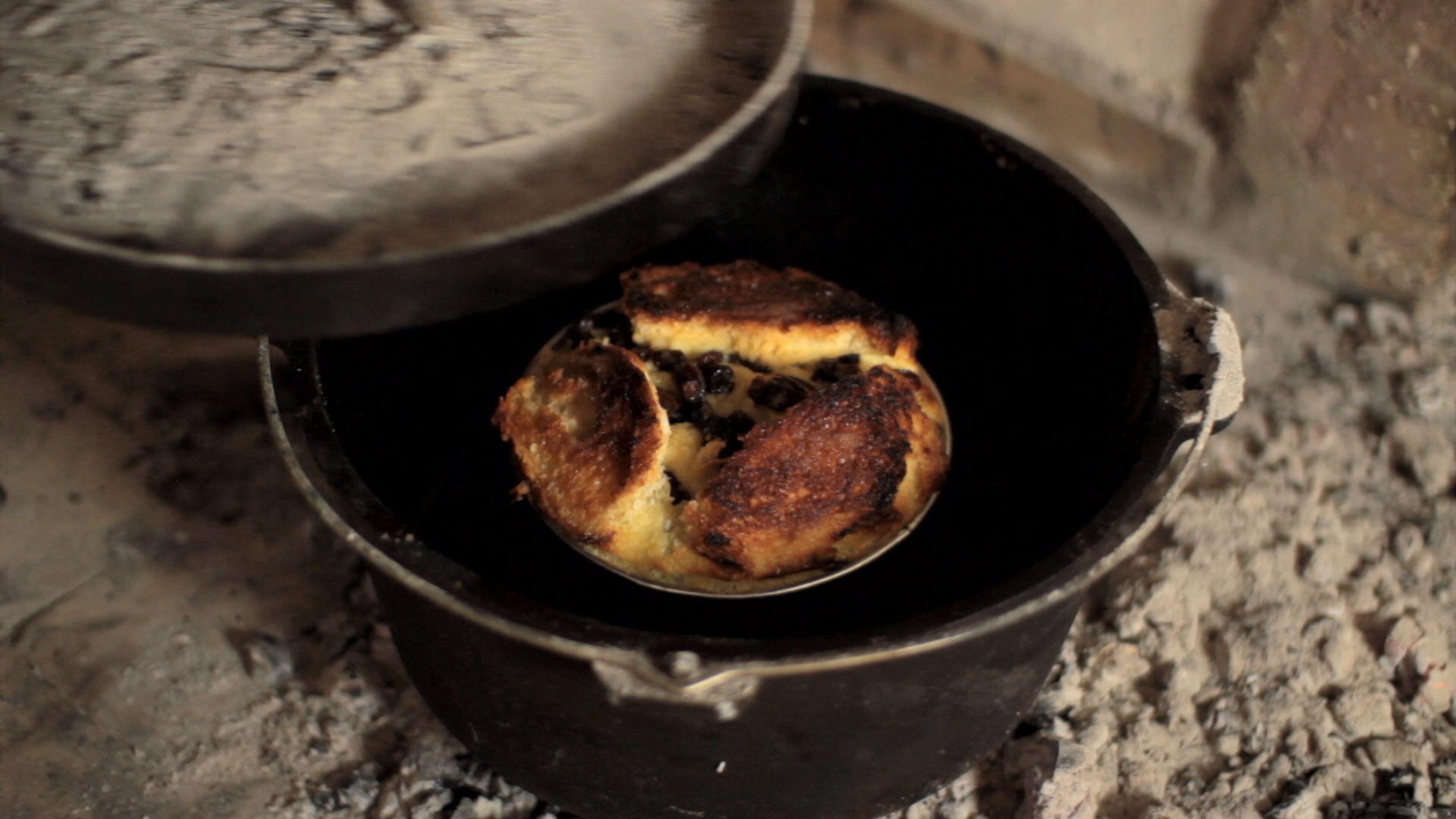
The name “White Pot” originates from the Devon region of England. But this sweet, buttery custard bread pudding, layered with sweetmeats (dried fruits) and topped with a caramelized sugar crust, was known to colonial cooks as well, if not by name, by construction. As far as we are concerned, this dessert deserves a culinary resurgence.
Notes:
You will need a sloped-sided baking pan for this recipe that holds about a quart, such as a Charlotte mould (said to be named after King George III’s wife), a trade kettle, or any other sloped-sided ceramic or metal vessel. We used a Tin Bowl in our video. A medium rectangular bread pan will work as well.
If you use your range oven at home, preheat your oven to 350-degrees (F). A wood-fired oven should be heated to full temperature and then swept out and allowed to cool to medium heat. If you use a Dutch oven, prepare a small fire from which you can use embers. Or if using charcoal briquettes with your Dutch oven, use this formula: for the ring of coals used beneath your Dutch oven, take the diameter of your Dutch oven in inches minus two (example: if your Dutch oven is 12” in diameter, use 10 briquettes beneath). For the ring of coals for the top of your Dutch oven, take the diameter in inches plus two (example: for a 12” Dutch oven use 14 coals on top). That will heat your dutch oven to approximately 350 degrees.
If you are using a wood-fired oven or Dutch oven, be sure to also use a trivet onto which you can place your baking pan. This will prevent the bottom of your White Pot from burning. If you don’t have a baking trivet, a tripod of pebbles will do in the meantime.
Ingredients:
1 pint heavy cream
1 cinnamon stick (or 1⁄4 t ground cinnamon)
1⁄4 t ground mace
1⁄4 t freshly grated or ground nutmeg
dash of salt
2 large eggs
1 large egg yolk
3 T sugar
1 loaf of white bread (we used soft Italian
bread, but white sandwich bread will work)
1⁄2 cup (1 stick) softened butter, plus enough
to butter the inside of your baking dish
1 cup raisins
1 cup dates, pitted, and sliced
additional sugar for sprinkling on top
Assembling:
Liberally butter the inside of your cooking vessel and set aside. Do not skip this step or you’ll be disappointed. Mix the heavy cream, spices, and salt. Set over medium/ low heat and bring to a simmer, occasionally stirring to prevent a skin from forming. Remove from heat to cool slightly.
Beat together the eggs, egg yolk, and sugar. When the cream mixture has cooled slightly, remove the cinnamon stick, and pour 2 to 3 tablespoons of the cream into your egg mixture, whisking as you pour until the cream is well incorporated. This will temper your eggs so they will not curdle. Continue to add approximately 1⁄4 cup of cream at a time to your egg mixture, whisking well as you pour, until all the cream is incorporated into the eggs. This is our custard liquid. Set it aside.
Slice your bread into approximately 1⁄2” slices, then trim away the crusts leaving only the slices of crumb. Butter your bread slices fairly liberally. This works best if your butter is softened.
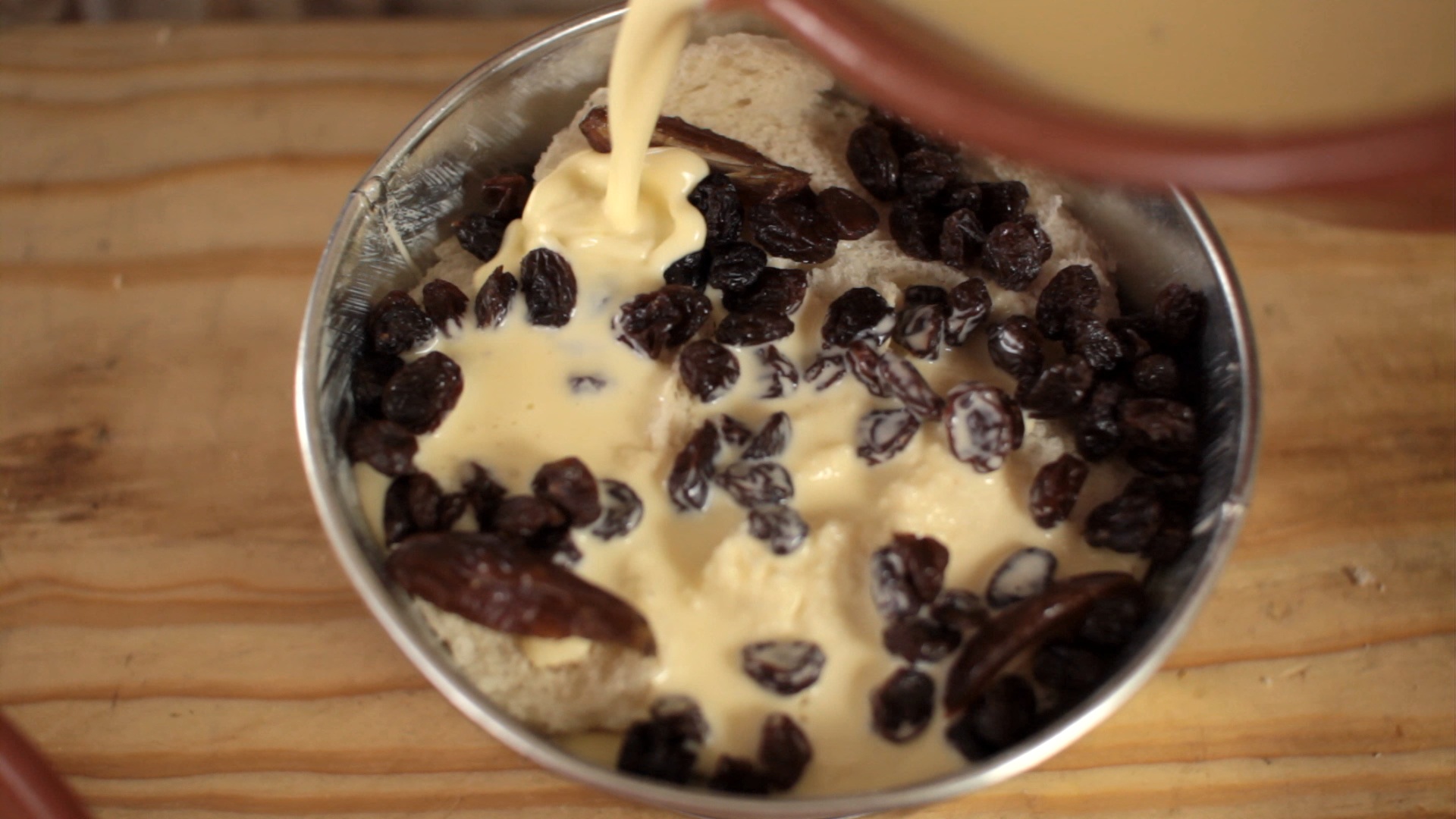
Place a layer of bread, buttered-side down, into the bottom of your buttered baking pan. Push your bread down just a bit, but take care not to compress it. Fill in any gaps with smaller pieces of bread. Sprinkle a layer of raisins and dates on top of your first bread layer. It does not have to be a solid layer of fruit, as the raisins will expand while baking. Repeat the bread layer once more, placing the buttered-side down. Top with another raisin/date layer.
Once you have two layers of bread and two layers of fruit, pour enough custard liquid to fill the pan just to the top of the bread. Repeat layering as described in the previous paragraph. Cover with just enough custard to cover the bread layer. Continue until your pan is full.
Top off your pan with a layer of bread, buttered-side up. The custard liquid will soak up into this layer. Sprinkle about a tablespoon of sugar on top. Your White Pot is assembled and ready to bake.
Baking:
Baking times will vary, depending on the size of your pan and the actual temperature of your oven. Check your White Pot after 30 minutes. The top will be well browned when it’s done. Your White Pot may jiggle a bit when jostled, but there should not be liquid pooled in the middle. If the top is not browned, continue to bake it, checking every 10 minutes or so to make sure it doesn’t burn.
Serving:
Once your White Pot is finished baking, remove it from the oven and allow it to cool for 10 minutes. Carefully run a knife around the inside edge of the baking dish. If you are using a tin-lined pan, be especially careful with your knife so you don’t damage your tin lining. Invert the pan onto a plate and rap on the pan and jiggle it to get the White Pot to separate from the bottom of the pan. This is why it is important to butter your pan liberally.
An extra special finishing touch for your White Pot is to sprinkle it with sugar and brown the sugar as you would on a creme brulee. To do this in a period manner, you can use a Salamander or an ash shovel. Heat the plate of the salamander until it is cherry red, and prop the plate over the sugared top until it bubbles and browns. (Be very careful doing this. Handling a hot salamander requires a good pair of thermal gloves). You may also brown the sugared top using a modern kitchen torch or a conventional oven broiler. If you use a broiler, watch your White Pot closely to avoid over browning.
Slice into wedges. White Pot may be eaten warm or cold. It is delicious topped with a little cream or sack (sweet sherry).
Just as it is across half of the United States, this part of Indiana where I live is under the oppressive effects of extreme drought. I’ve given up on my lawn. The grass crunches beneath my feet and breaks off at the ground with each step. I fear spontaneous combustion should the sun even look at it wrong. The only signs of life in my yard are the towering weeds which have shown themselves once again to be the most well-equipped to survive.
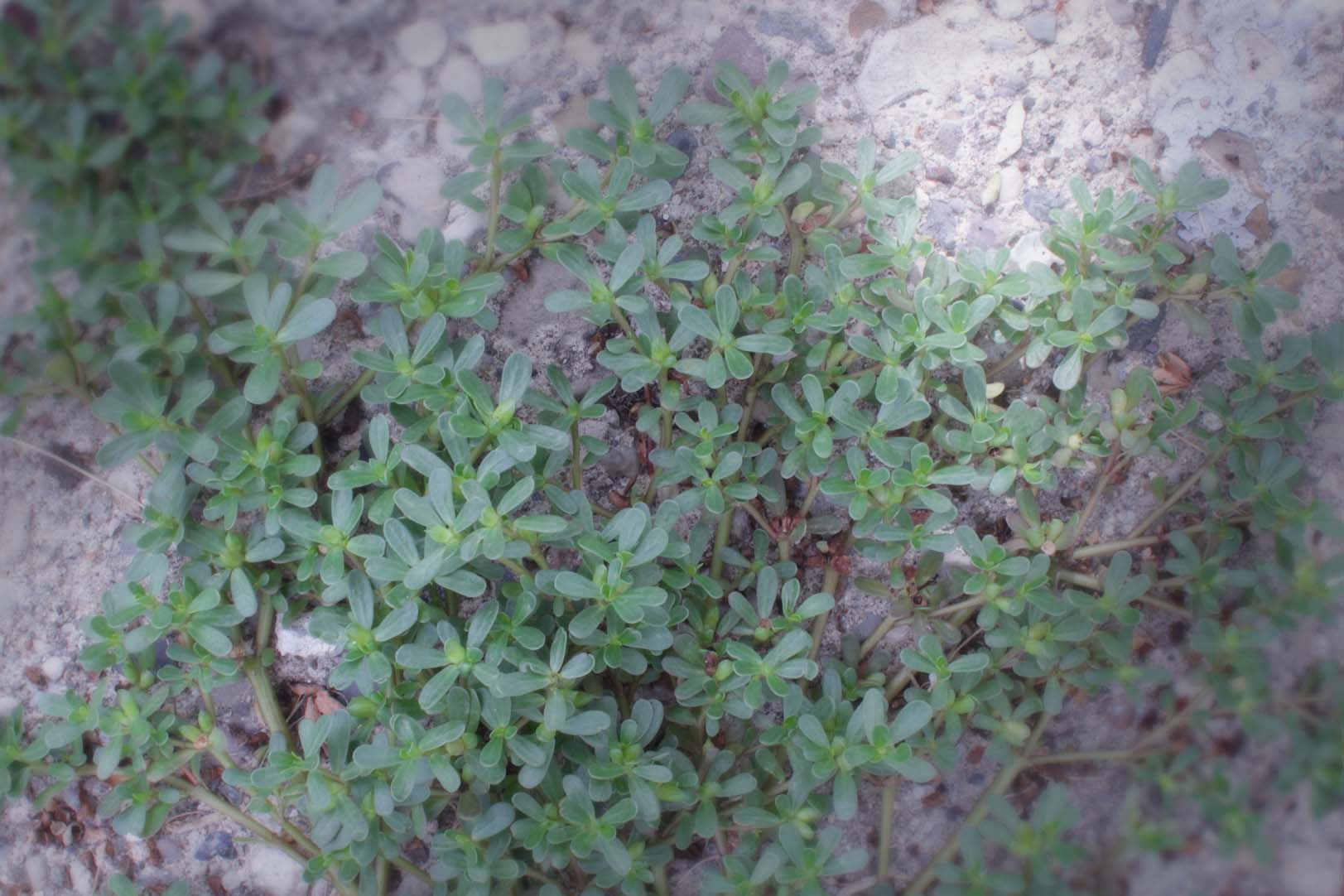
The other day I braved the heat and went outside to uproot those few remaining living things. I felt a bit “Grinchy” doing so. As I made my way to the front of the house where the tallest stand thrived, I was delighted to find a splayed-out clump purslane growing up through the crack in my scalding hot sidewalk.
Purslane is considered an exotic weed in most parts of the U.S., but there is some fossil evidence that it was at one time native to North America. It is common throughout many parts of the world. It’s a succulent plant that stores water in its leaves, stems, and roots. It reminds me of a diminutive version the jade plant I have growing in my living room. Both purslane and my jade plant seem to be equally resistant to drought.
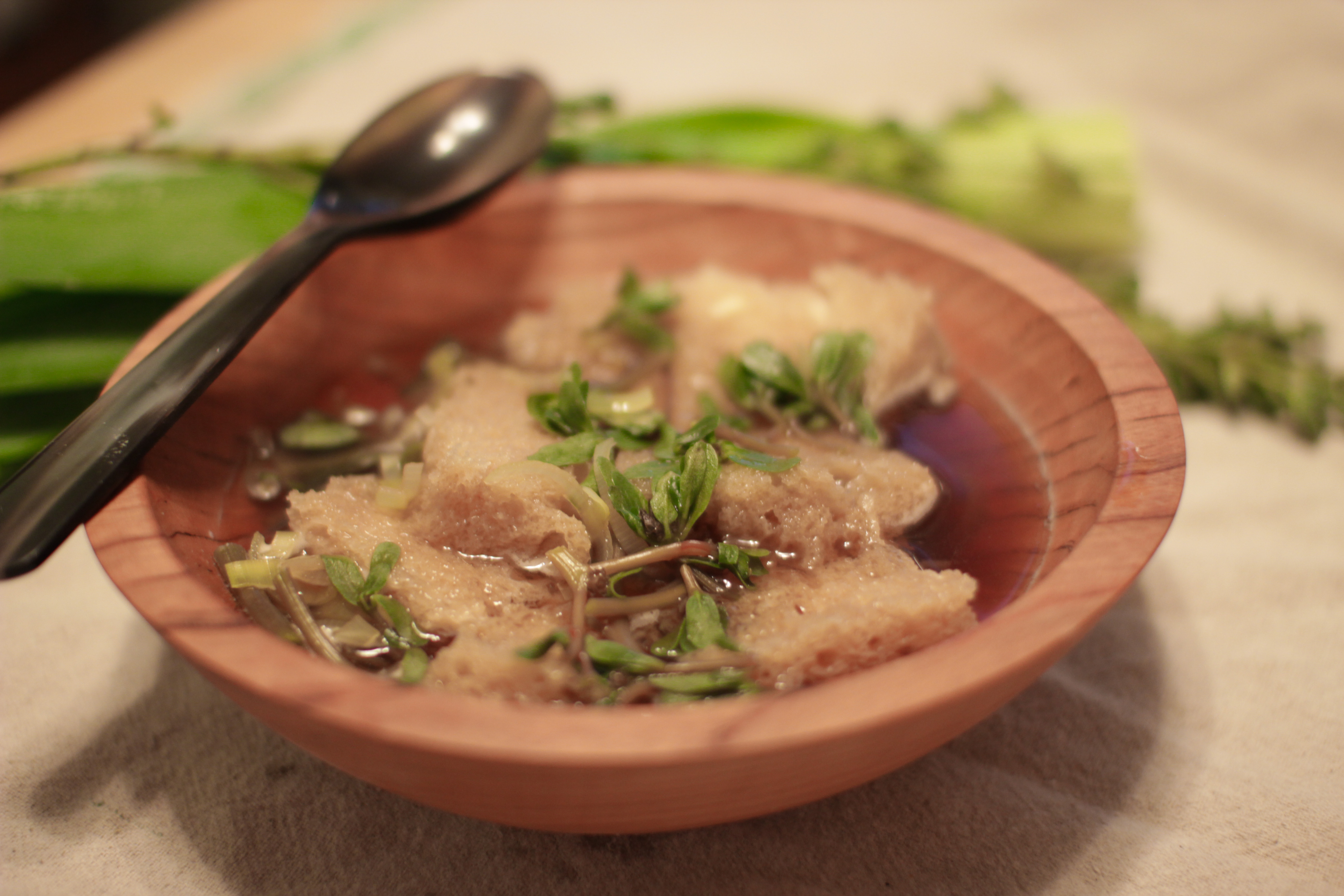
A nice bowl of simple soup made of beef broth, leeks, and morning purslane, seasoned with salt and pepper, and served over croutons of hearty bread.
Both the stalks and leaves of purslane are edible. It has a snappy texture and its taste can vary depending on the time of day it’s harvested: pick it before the sun rises and it can have a slightly tart flavor; by midday, it’s likely to taste more mild with a hint of earth. And what’s especially nice about this plant is that it’s extremely high in Omega-3 oils — more so than any other leafy plant you can find in the produce section. It’s also high in Vitamins A, B, and C. If you suffer from kidney stones or gout, however, you may want to be careful about making purslane a regular addition to your diet, as it also contains high levels of oxalate, a contributor to these ailments.
Purslane can be found in a number of 18th century cookbooks. It was typically used in soups and stews, as well as eaten raw in salads. It was also used as a garnish, often being blanched and pickled. Here are a few recipes:
A New and Easy Method of Cookery, Elizabeth Cleland, 1755
The Compleat Housewife, Eliza Smith, 1739
By the way, a “walm” is a bubble according the O.E.D. Boil the stalks in salted water for a dozen bubbles…in order words, blanch them.
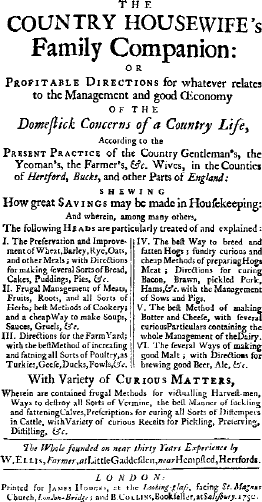
Here’s a link to an excellent resource for best (and worst) cooking, food-preparation, and home-remedy practices of southern England, compiled and published by William Ellis in 1750.
Who doesn’t like a nice big plate of French Toast? For me it brings back fond childhood memories of Saturday mornings — usually during the holidays when no one seemed to be in a hurry to change out of our pj’s to go anywhere. Truly, French toast a quintessential breakfast food, though I’ll eat it for any meal if given a chance — especially if it’s served with real maple syrup, a dab of melting butter, and maybe some fresh fruit or berries on the side.
But did you know that this delectable dish we call French Toast has been around for over a thousand years? And it wasn’t always breakfast fare, in fact, it likely started out as a dessert.
The earliest documented recipe for French toast can be found in the Apicius — a collection of 4th and 5th century Roman recipes. The dish is simply titled, “Another Sweet.” Its translation reads:
“Break a slice of fine white bread, crust removed, into rather large pieces. Soak in milk and beaten eggs, Fry in oil, cover in honey, and serve.”
Bread was known as the staff of life. It was the dietary pillar of cultures around the world. But what was one to do when their bread went stale?
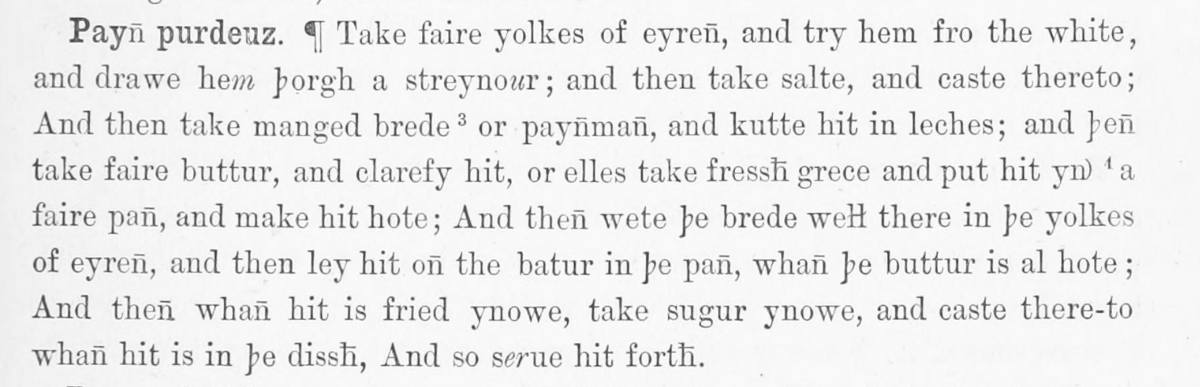
In an old nameless English cookbook from 1430, later compiled and published under the name “Two 15th Century Cookery Books,” We find a recipe for bread dipped in egg yolks, fried in butter, and sprinkled with sugar.
“Eyren” is an old plural form of the word “egg.”
The name of this dish is the French word, “Payn Perdeuz,” meaning “Lost Bread” or “Wasted Bread,” suggesting the recipe was intended for bread that had gone stale. This name seemed to stick for many years in the vocabulary of English cooks.
Karen Hess, who transcribed Martha Washington’s Book of Cookery, says,
“The English early took to pain perdu and made it their own; it was rarely omitted from a cookbook, usually listed under “made dishes”…or any dish that amused the cook or showed off her skill.”
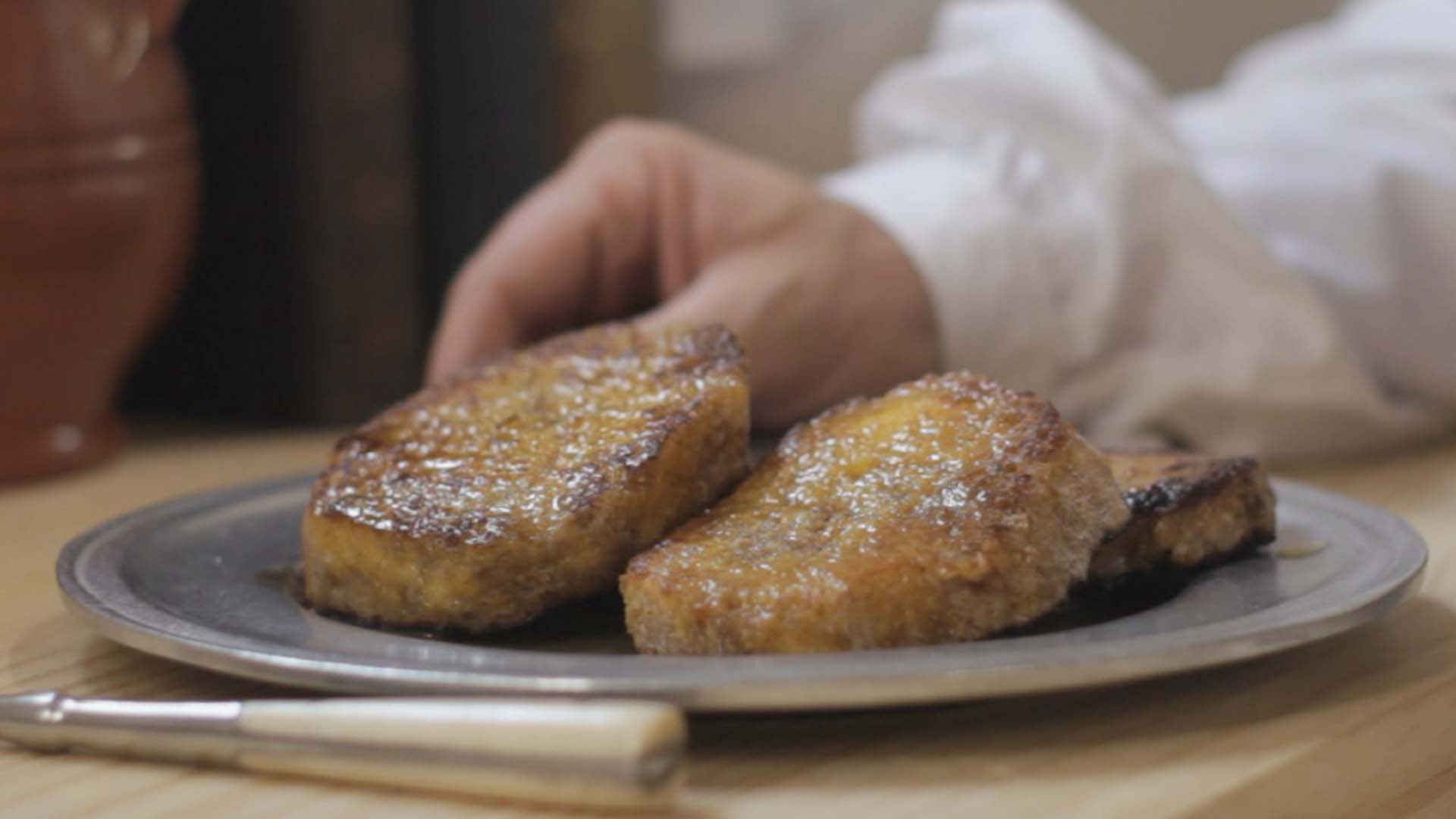
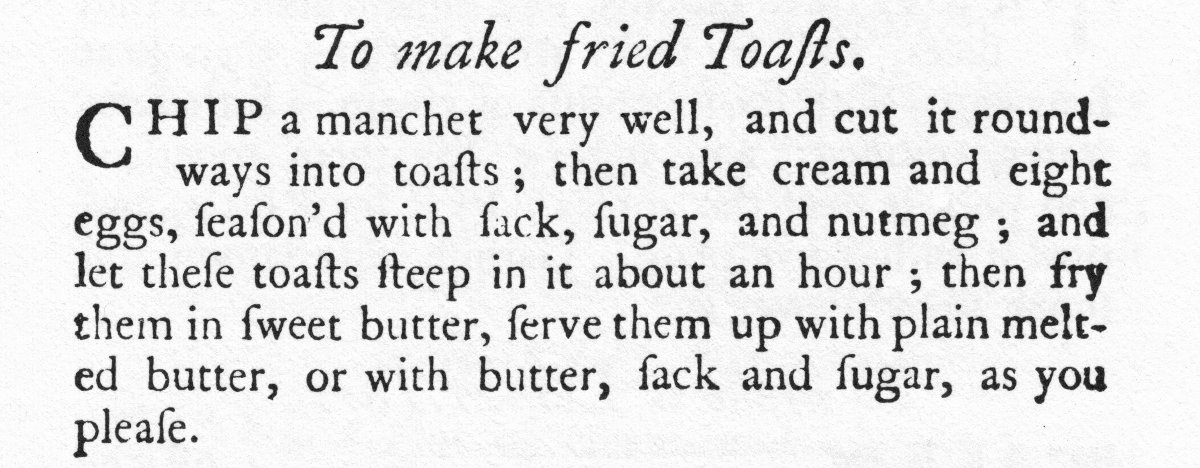
Here is our take on an 18th-century recipe for Payn Perdue:
1 – Medium loaf of firm enriched bread. (The No-Knead “French” Bread in our most recent video would make a perfect choice. If you’re not up to making your own bread, Challah, Brioche, or a Country French loaf will work perfectly. Stale bread is better. You can leave it out overnight if you need to, out of reach of the critters)
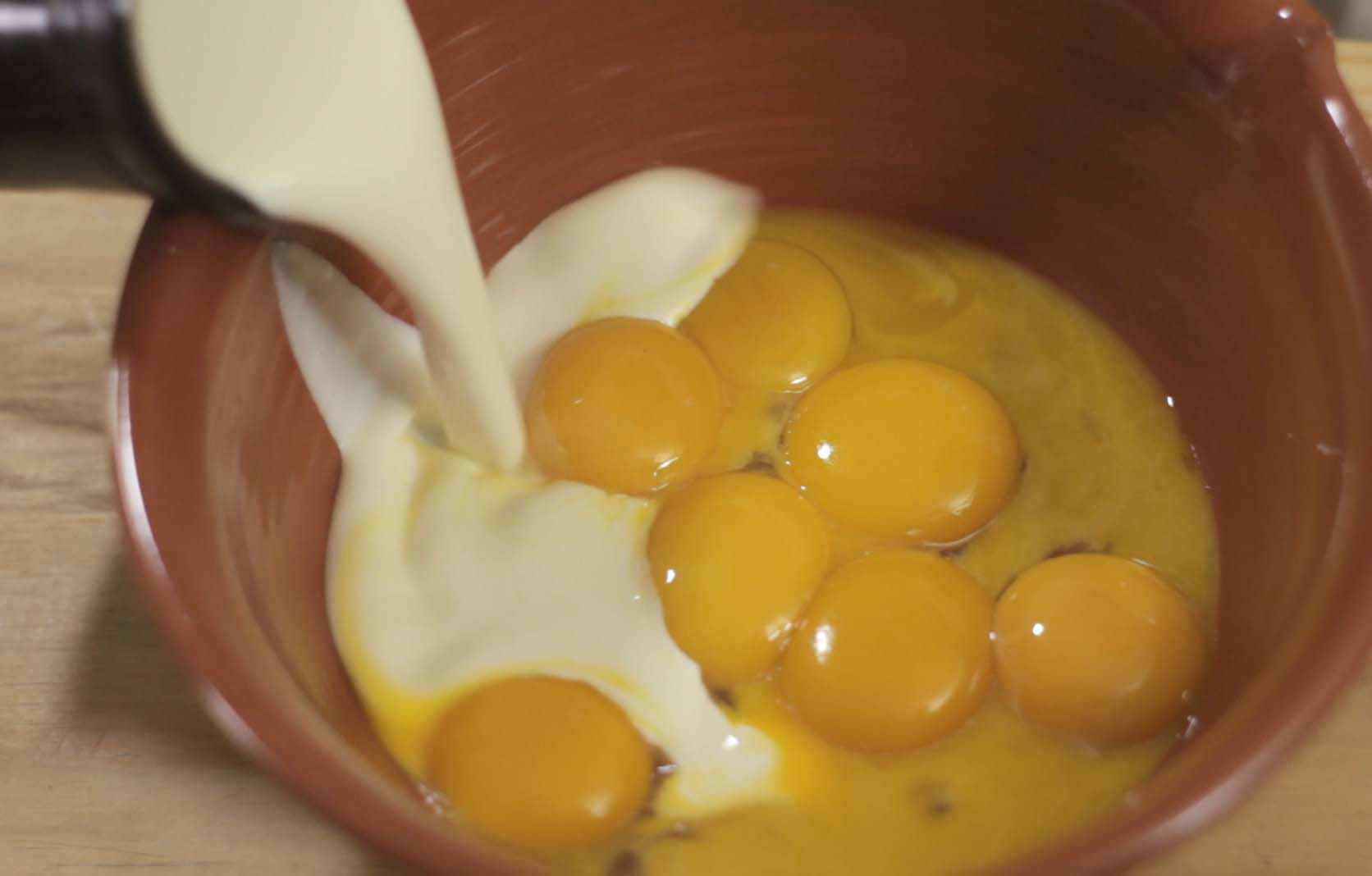
8 – Egg yolks
1 Cup of Cream
1/4 Cup Sweet Sherry
1-1/2 Tablespoons Sugar
1/2 teaspoon Grated Nutmeg
Take a sharp or serrated knife and slice off all the outer crust of the bread. Cut the remaining crumb into slices about 3/4″ thick.
In a bowl, mix the egg yolks, cream, sherry, and sugar. Season with grated nutmeg.
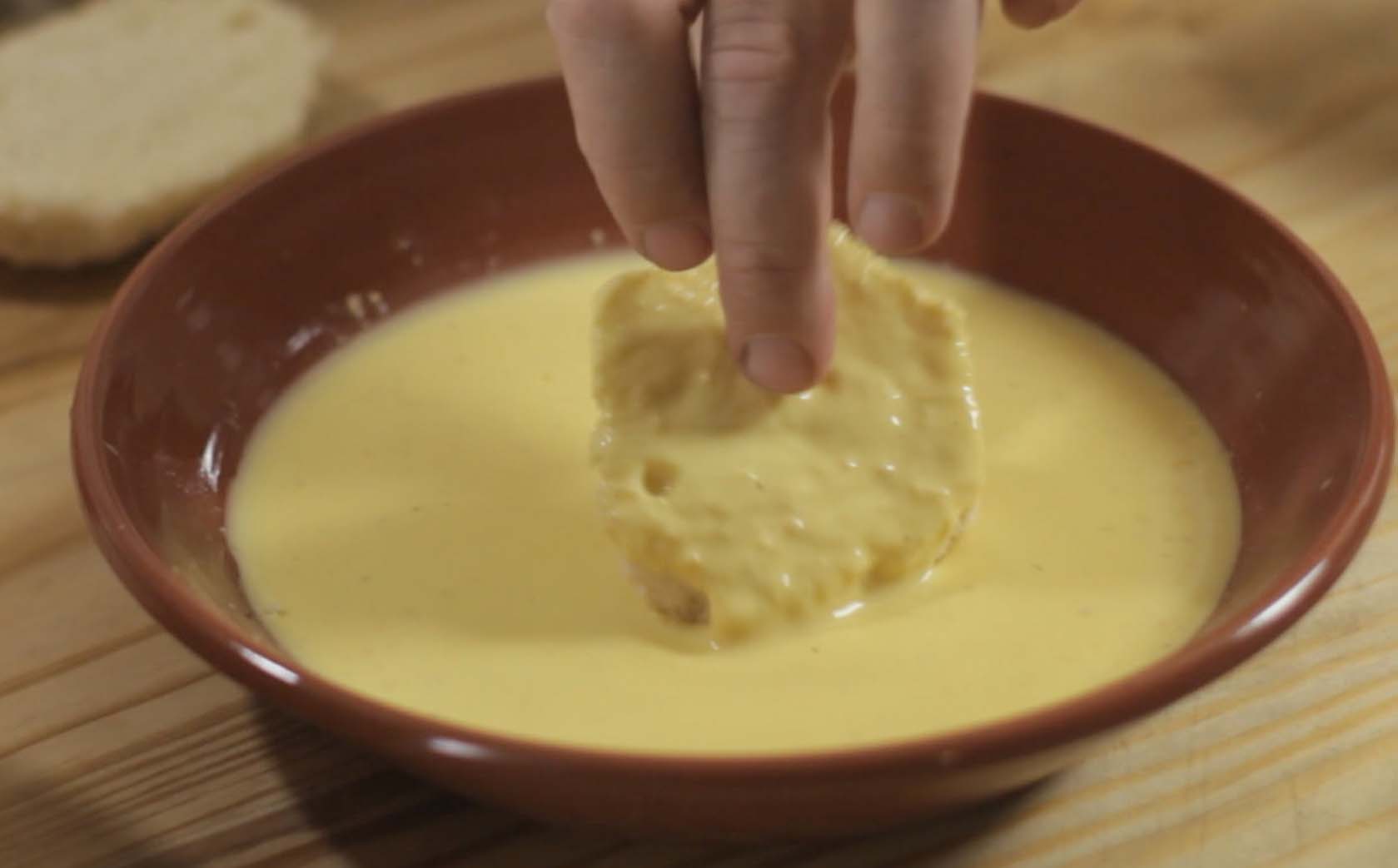
Dip the bread slices in the egg mixture, making sure you get the edges as well, and set them on a plate for a while — 15 minutes should do, unless your bread is really stale, then it might take longer.
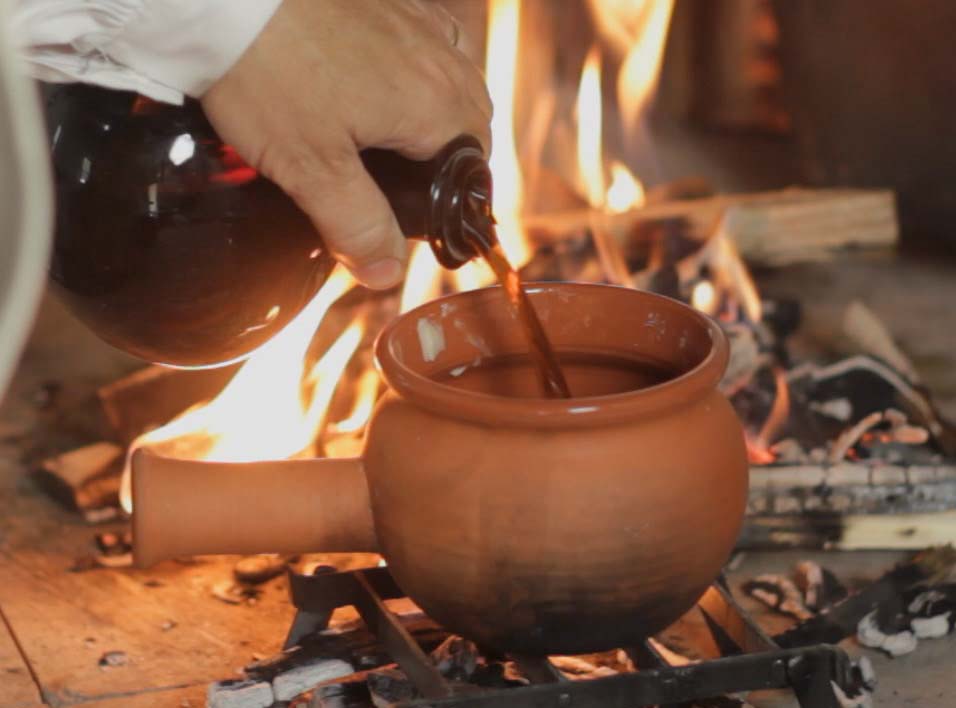
While the bread slices are sitting there soaking up the egg mixture, go ahead and mix the melted butter, sherry and sugar for the sweet sauce. Set this nearby for serving your toasts.
Melt 3 to 4 tablespoons of butter in a large skillet over medium heat. You may have to be very careful handling the bread at this point, depending on the type of bread that you use. When your butter has stopped bubbling and it’s quieted down just a bit, fry your payn perdue slices on both sides until they are a golden brown.
Pour the sweet sauce over your slices and serve.
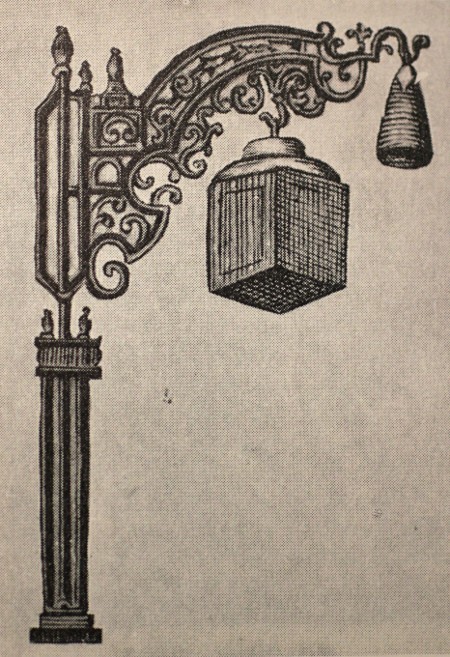
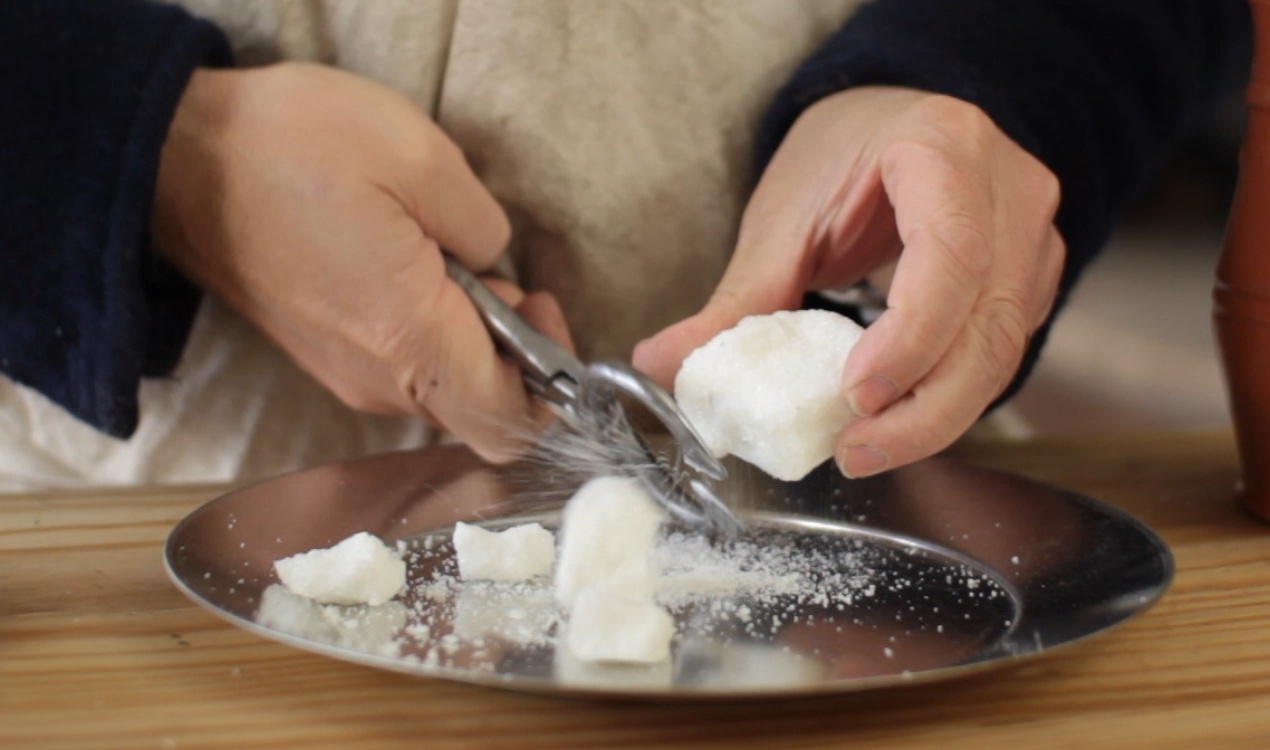
Refined white sugar in the 18th century came in cone-shaped cakes, wrapped in blue paper. Sugar Nippers were often employed to break it apart.
For authentic alternatives to our 18th century sweet sauce, you can also use honey, light molasses, maple syrup, or you can simply sprinkle it with sugar and a bit of ground cinnamon.
A sweet and sour alternative that is likewise very authentic, would substitute verjus for the sherry. Verjus is the unfermented juice of unripe grapes. It was commonly used in the 18th century for pickling and spicing up sauces in place of vinegar. It’s available online.





















 Savoring the Past