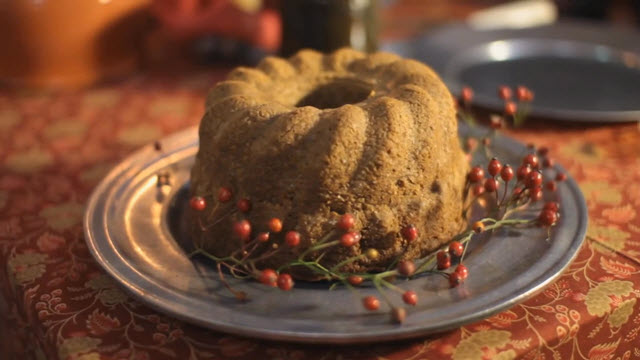
Today we’re making Amelia Simmons’ tasty Indian pudding from her 1796 cookbook, American Cookery.
3 cups Milk
1 cup Cornmeal
1 egg well beaten
2 ounces Butter
1 teaspoon Salt
1 teaspoon Ginger
1 teaspoon Nutmeg
¼ cup Molasses
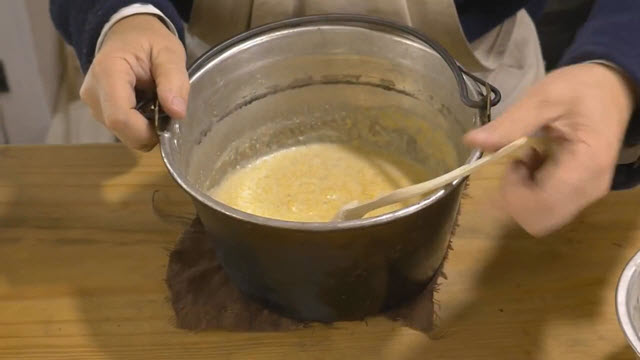
Bring milk to a gentle simmer on fairly low heat constantly stirring so milk does not burn on the bottom. Once simmering, add cornmeal and continue stirring and cooking until it thickens. Remove from heat and allow to cool just enough that it does not cook the egg when added. When cooled enough, add egg, butter, spices, and molasses and stir until well mixed and the butter is melted.
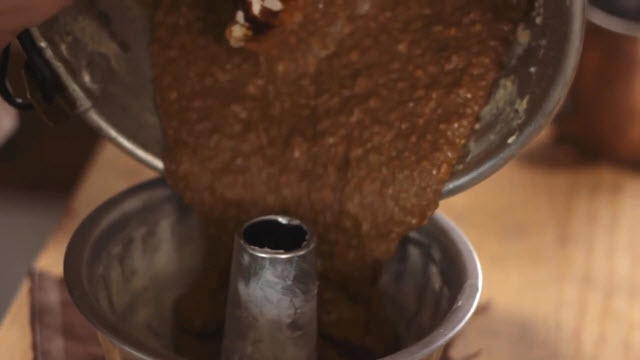
Pour into well buttered mold and bake at 325 degrees for about an hour and a half.
Transcript of Video:
We’re right in the middle of a series. We’re making an American holiday meal based off of a recipe from Amelia Simmons’ 1796 cookbook, American Cookery. Today we’re making her tasty Indian pudding.
We’re starting off with 3 cups of milk and we’re going to scald this milk and bring it to a simmer and then I’m going to add 1 cup of cornmeal. While this is cooking, I’m going to keep stirring it because I don’t want it to burn on the bottom. We’ll know when we’re starting to get there when this really starts to thicken up. What we’re doing is here is making basically a hasty pudding with our cornmeal, so don’t get in a hurry with this. Keep this on a fairly low heat. Make sure to keep stirring it so that it doesn’t lump up. This is really nice and thick, it’s time to take it off the fire.
Okay, this is already starting to thicken. We want to add our final ingredients. I’ve got 1 egg that’s well beaten. This mixture should be warm, but cool enough so that when you add your eggs, they don’t get cooked. We also have a couple of ounces of butter.
I have a teaspoon of salt, a teaspoon of ginger, and a teaspoon of nutmeg.
Our final ingredient is a ¼ of a cup of molasses.
We want to stir it until it’s all incorporated and all the butter is melted, and then we can pour this into a mold. I’m going to use one of our Turks hat molds, and make sure it’s well buttered so that you can get it out easily.
We need to bake this, probably an hour and a half or so at 325 degrees. Let’s get this in the oven.
That turned out beautiful! Now right now I would sample this, but we’re going to have to wait to put this whole feast together. I want to thank you for joining us today as we savor the flavors and the aromas of the 18th century.
In half of milk, dissolve pearl ash. In other half of milk, dissolve alum. Combine all mixtures together and stir very well. You will end up with a very stick batter.
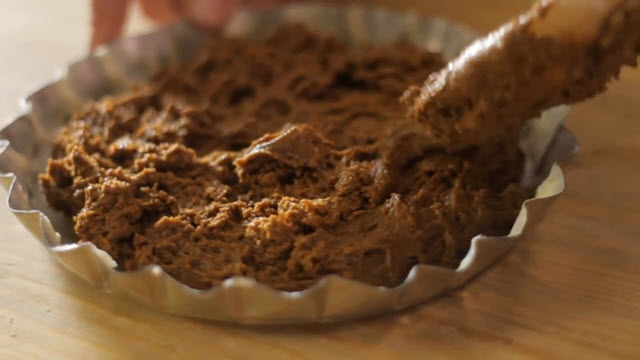
Pour into dish that has been well buttered. Bake at 400 degrees for about 15 minutes.
Transcript of Video:
In this episode, I’m taking a step into the future. Well, not really so much the future. Normally we focus on the 18th century. In this episode, we’re going to be doing an early 19th century recipe. The recipe I’m making today is from John Cook’s 1824 cookbook, Cooking and Confectionary. This is what’s called a light gingerbread. I’ll explain in a minute exactly why this is so special. Thanks for joining us today on 18th Century Cooking with James Townsend and Son.
Today’s episode is the final companion piece to our exploring the 18th Century discussion where we talk about chemical leavening. So while this recipe that we’re doing today is actually a fairly simple, common sort of gingerbread, one of the interesting things is, it uses alum as one of the leavening agents, so in our “Exploring the 18th Century Chemical Leavening” series, we talked about bread adulterants in the mid-18th century and how there was great alarm at the bakers using alum in their bread and yet here we have an early 19th century recipe that’s using alum as a leavening agent.
The original recipe is rather large, so I’ve downsized this considerably. We’re going to start with 2 cups of flour. To this, I’ll stir in 2 teaspoons of powdered ginger. Next, I’ll add 1 cup of light or Barbados molasses. Warming this first will make it easier to mix into the flour.
Now for our wet ingredients, I’ll take a few tablespoons of milk divided evenly. In half of this milk, I’ll dissolve ¾ of a teaspoon of pearl ash. In the other half, I’ll dissolve 1 teaspoon of alum. Pearl ash can be very difficult to find, so James Townsend and Son now carries food grade pearl ash in 2 ounce bottles. You can substitute it with baking soda, but baking soda was a mid-19th century invention. Alum can be found in the spice section in your local grocer. If you would prefer not to use alum, you can use a couple tablespoons of vinegar instead. Now I’ll stir this in very well. The result is a very sticky batter.
I’m going to bake this in a tart tin that has been well buttered. If you’re baking this at home, you’ll want to preheat your oven and bake this at 400 degrees for about 15 minutes.
We’ve got to give this a try.
Mmm. Very wonderful, very fluffy. It’s got a great gingerbread taste with the mix between the ginger and the molasses. This is an excellent, very interesting, almost like a ginger cake. Very moist though. This is really something special.
If you haven’t watched our “Exploring the 18th Century” Series on chemical leavening, I really invite you to do so. It really helps tease out and get to the roots of chemical leavening all throughout the 18th and 19th century.
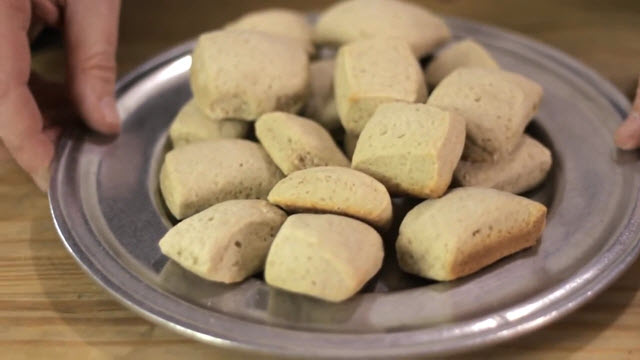
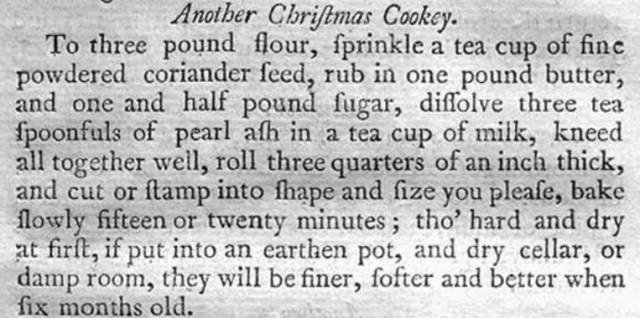
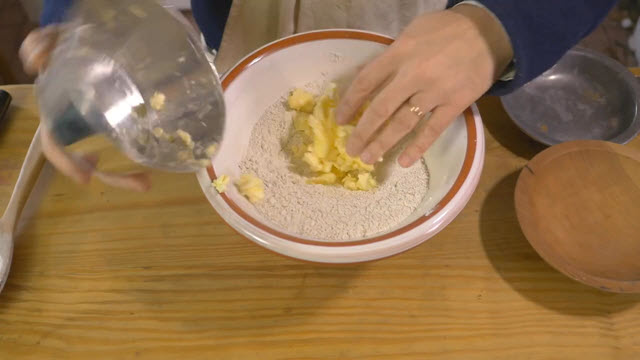
Mix together flour, sugar and coriander, then rub in butter. Dissolve pearl ash into sour milk then mix into other ingredients. Knead for 5-10 minutes adding flour as needed.
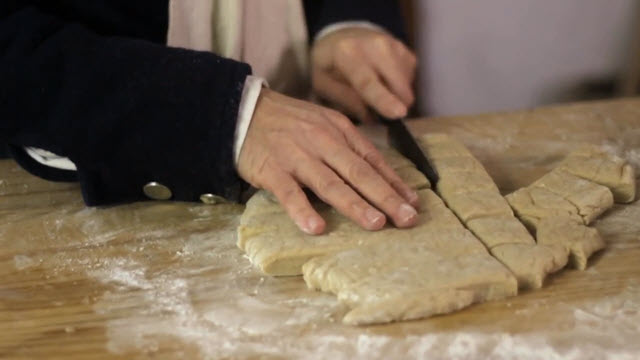
Roll out to ½ to ¾ of an inch thick and cut as desired.
Bake at 325 degrees for 25 minutes.
Transcript from Video:
Recently in our “Exploring the 18th Century” series, we’ve been discussing chemical leavening and then going in depth into that topic. Today we’ll be starting a companion series of cooking episodes that goes with that. Thanks for joining us today on 18th Century Cooking with James Townsend and Son.
The recipe today is called a Christmas cookie. It’s from Amelia Simmons’ 1796 cookbook, American Cookery. It’s very interesting here, a couple of different things. The first thing is that it’s called a Christmas cookie. It’s not something you normally see in an English cookbook. This is an American cookbook. She’s definitely got some Dutch influence here. You can also tell not only by Christmas being included in it, which isn’t a normal kind of big celebration in the 18th century for English, but also the word cookie, which is a reference to the Dutch word koekje, or their version of a cookie, and the third interesting thing about this recipe is that it uses pearl ash as the leavening agent and we have a pearl ash here. It’s an item that we’ve started carrying at the store. We have this available in little 2 ounce packages, so you can experiment with pearl ash too. Pearl ash is a refinement, or a component of the alkaline potash, which is extracted from burning trees or other vegetable matter. It’s typically used in soap making and in dyeing and other industrial processes, but when this alkaline component is mixed with an acid in baking, you get a leavening effect.
Now this recipe is a very simple one. We start off with 3 ½ cups of flour. To our flour, we will add 1 cup of sugar and 3 tablespoons of powdered coriander. For a lighter texture, I will rub in about 10 ounces of butter into our floured mixture. Our wet ingredients are very simple. I have 1 ¼ cup of sour milk. If you don’t have sour milk, you can take regular milk and add, say, a tablespoon of lemon juice or vinegar to that. To our sour milk, let’s add ½ a teaspoon of our pearl ash. It needs to completely dissolve before we add it into our dry ingredients.
Once this is mixed well, it should be kneaded 5-10 minutes. If it’s too moist, add a little extra flour.
Once we’re done kneading this, we can roll it out to ½ inch or ¾ of an inch thick.
Once you’ve got it rolled out, you can cut this into any shape you like. I’m just going to cut simple rectangles.
Today, let’s bake these in a new product that we haven’t used before in the kitchen. Here is our little reflector oven. This is very similar to reflector ovens you see in the 19th century and we think they go back to the 18th century, but we’re not really quite sure exactly how far back they go. This is a perfect little tool for baking little items like this. In a home oven, you can bake these at about 325 for, say, 25 minutes.
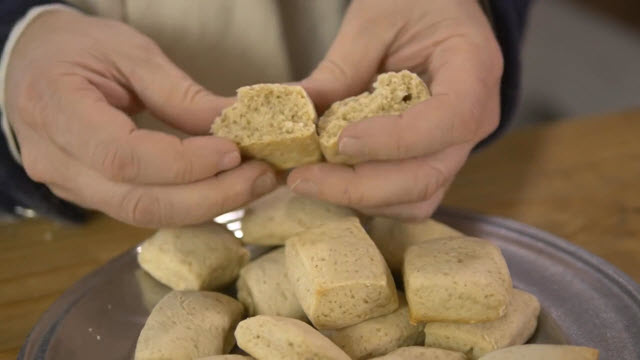
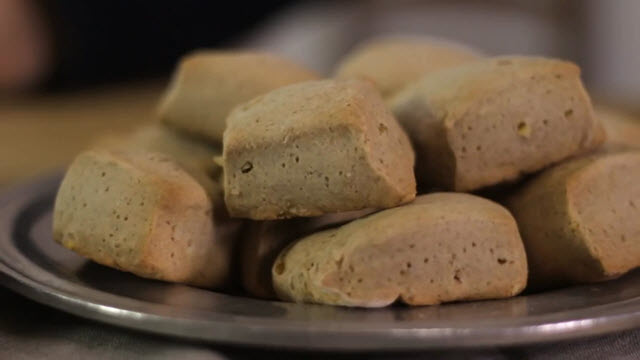
Notice the wonderful crumb. This pearl ash makes a wonderful light and fluffy cookie. These look great. I’m sure they taste great. Let’s try them out.
Mmm, wow, that coriander flavor, completely different than what you’re probably used to. Very light and fluffy. These aren’t too chewy. They smell really nice. You should try these cookies out. I want to thank you for joining us today as we savor the flavors and the aromas of the 18th century.
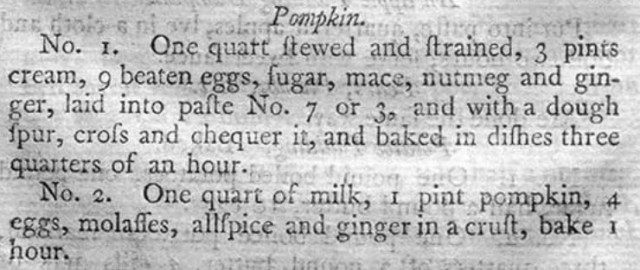
Today we’re going to be baking a pumpkin pudding, or as we know it, a pumpkin pie from Amelia Simmons’ 1796 cookbook, American Cookery.
1 pint Pumpkin
1 quart Milk
4 Eggs well beaten
½ cup Molasses
1 teaspoon Ginger
1 teaspoon Allspice
2 Pie Crusts
Cut pumpkin in half, gut and bake upside down at 350 degrees for about an hour to soften. Peal and mash then add milk and mix. Next, add eggs, and molasses. Finally, mix in spices and pour into pie crust.
Bake in oven at 325 for 75 minutes. Allow to cool before eating.
Transcript of Video:
In the last several episodes, we’ve been doing American Holiday recipes from Amelia Simmons’ 1796 cookbook, American Cookery. Today we’re going to be baking a pumpkin pudding, or as we know it, a pumpkin pie. Thanks for joining us today on 18th Century Cooking with James Townsend and Son.
You know, when we first read this recipe, we really weren’t quite sure. It seemed that the proportions really just weren’t going to work out, but we tried it anyway, and trust us, it works. Our recipe starts off with pumpkin. It calls for 1 pint of pumpkin. The best way I found to prep our pumpkin is to actually slice our pumpkin in half and take out the innards and then turn them upside down on a baking sheet and bake them for about an hour or so at about 350 degrees and that gets them nice and soft and the skin peels easily away and we can get our pumpkin out without any work at all. If you want to cheat and do it the simple way, just buy a can of pumpkin. That’ll work just as well. It looks like about half of this small pumpkin is going to be our pint.
Okay, that looks really good. Now we’re going to add 1 quart of milk. Now, this is where it was tricky, seemed like 1 quart of milk was going to be way too much. Let’s get this mixed in here. Our mixture’s very, very soupy. Now were going to add 4 eggs that we’ve already whipped together, and the recipe calls for molasses. Now, she doesn’t tell us exactly how much to use. I played around with this recipe a bit and a half a cup is probably about right. We’re not using a black strap molasses, but any grade of a lighter grade of molasses.
Our last ingredients are spices. We’re going to need a teaspoon of ginger and a teaspoon of allspice. We’re going to pour our pie filling into our pie crust. You can use any short paste for this recipe. It will work great. We did a previous episode on a short paste, so make sure to check that out.
This recipe makes enough for probably 2 pies. This will need to bake about an hour and 15 minutes, maybe an hour and a half at 325. This recipe actually calls for a lattice on top of this pie crust, but it turns out that this is so liquidy that it just sinks to the bottom, so just make this an open top pie.
Boy, this pie looks great, and I love pumpkin pie. Normally I’d be digging into it right now, but we’re just going to have to wait. We’re going to wait until this final episode of the series where we put together this whole feast based on the Amelia Simmons’ cookbook. I want to thank you for joining us today as we savor the flavors and the aromas of the 18th Century.
Rub lard into flour and set aside. Mix milk and molasses together. Dissolve pearl ash completely in water and add to milk. Quickly mix milk into flour mixture until blended and turn out onto a floured surface.
Roll into ½ to ¾ inch sheet and cut as desired.
Bake at 400 degrees for 16-18 minutes.
Transcript of Video:
In just a little while, I’m going to be making a recipe that’s very unusual and very interesting. It’s not a recipe from a cookbook, but it’s actually a recipe from an editorial, or a letter to the editor, 1799. This episode is a companion piece to go along with our “Exploring the 18th Century” series where we’re talking about leavening or chemical leavening.
If you haven’t watched Exploring the 18th Century, I encourage you to do so. We are discussing in depth our research into chemical leavening in the 18th century and that will help give you a much greater context for the recipe that I’m making today.
Today’s recipe is for what was call American potash cake. As I mentioned in the introduction, it’s found in a letter to the editor in the London Monthly Magazine. This letter was written by Margaretta Curly, who at the time was living in New York. In her letter, Mrs. Curly expounds on the benefits of a cake that uses no yeast. Rather, she uses potash or pearl ash which is an alkaline that reacts with an acid creating carbon dioxide bubbles that lightens or leavens your cake as it bakes. Mrs. Curly wrote about how these cakes could be made in minutes rather than hours and they were especially handy when yeast wasn’t readily available. She also wrote about how these cakes could be made using a variety of ingredients.
Today we’re using her suggestion for making them with rye and molasses, because sugar and white flour were scarce in various regions in North America. I’m cutting the original recipe in half and I’m using a pound of rye flour. It’s about 4 cups. You can use wheat flour if you wish. To this, I’ll rub in 4 ounces, or about, say, 8 tablespoons of pork lard. If you don’t want to use pork lard, you can use butter instead.
Once I have these combined well, I’ll turn to my wet ingredients. I’ll start with a cup of sour milk. Now if you don’t have sour milk, you can take fresh milk and add about a tablespoon of lemon juice or vinegar. To this, I’ll add 4 ounces, that’s about a half a cup, of light or Barbados molasses. You really don’t want to use black strap molasses. It’s too strongly flavored. You can use 4 ounces or a half a cup of sugar instead if you wish.
Now before I’ll add our dry and wet ingredients together, I’ll take a ½ a teaspoon of pearl ash and dissolve it completely in a quarter of a cup of water. Add this to your milk mixture and quickly add that to your flour.
We now offer pearl ash at James Townsend and Son. You can substitute baking soda, but that is a mid-19th century invention.
Mix this until blended and then turn out onto a floured surface. Roll it out to about ½ or ¾ of an inch thick.
You can cut these any shape you wish. I’m using a biscuit cutter.
You want to bake these at about 400 degrees for 16-18 minutes.
Now notice the crumb on this. It’s very light and fluffy. That’s definitely the work of the pearl ash. Well, it’s got a really nice flavor, a bit like, say, you know, a breakfast biscuit, but with the molasses and the rye flour, it’s definitely got a nuttier flavor, and one of the interesting things I thought about this recipe was that there was no salt, so you can tell it’s a little lacking in salt, but really not bad at all. I think the potassium in the pearl ash really helps give it a little of salty flavor anyway.
Now I went ahead and also made a recipe using regular wheat flour instead of rye flour and using butter instead of lard. Now that rye and lard flour version is very, very inexpensive. This is a more expensive version, but let’s see how this turned out. It’s got sugar instead of molasses too, so it’s missing that molasses flavor, much more like what you would expect as a modern sort of breakfast biscuit. It’s a little bit sweeter. You know, it actually almost reminds me of a shortbread that you would use for strawberry shortbread. It’s kind of that sweet and that kind of yummy.
This recipe of Mrs. Kerlie’s in 1799 in this London Monthly Magazine gives us a great little snapshot of something that’s going on right there in the Hudson River valley, where we see this knowledge being spread from the Dutch community, probably right there in the mid-18th century, and it spreads, where she’s giving that knowledge about how you can leaven breads, not with just yeast, but with this new method.
Anyway, a couple of years later, the recipe was published in the Domestic Encyclopedia of London. In 1808, Duncan McDonald picked up the recipe and included it in his cookbook, The New London Family Cook and while chemical leavening was much more quickly accepted in North America than in Great Britain, it does begin to slowly emerge in the 1820’s and 30’s in English cookbooks.
Again, if you haven’t watched our “Exploring the 18th Century” series where we’re discussing chemical leavening, I really encourage you to do so. We really get to go in depth and tease out these ideas of where chemical leavening comes from.
Today’s recipe, a 17th century carrot pudding, comes from The Compleat Cook by Rebecca Price.
6 ounces Breadcrumbs (or Cornmeal)
4 Egg Yolks
2 Egg whites
1 cup Milk
1-2 tablespoons Honey (or Maple Syrup)
2 ounces Sack (Wine)
Pinch of Nutmeg
8 ounces Shredded Carrots
2 ounces Melted Butter
Mix together eggs well beaten, milk, honey and Sack.
Add nutmeg, carrots, and breadcrumbs.
Add in melted butter and enough milk to make the consistency of batter. Pour into well buttered dish and bake at 350 degrees for 35-40 minutes.
Transcript of Video:
In the episode today, we’re going to be baking a 17th century carrot pudding. Thanks for joining us today on 18th Century Cooking with James Townsend and Son.
Carrots are perfect for this time of year in the early spring. These root vegetables have been held over from last fall, so that’s what we’re going to cook with today.
Today’s recipe comes from The Compleat Cook by Rebecca Price. This book is available online. You can usually find it used. I don’t think it’s currently in print. Rebecca Price’s book is a manuscript collection of recipes from the late 17th century, somewhere around 1680. We can tell it’s a collection, because she calls this recipe a carrot pudding baked, my Lady How’s Recipe. I went digging through the old cookbooks and I found very similar recipes throughout the 18th century. There’s even one here in Primitive Cookery which is one of the cookbooks that we offer.
So this is a very simple recipe to put together. We start off with bread crumbs and what she calls for is the crumb of a two penny loaf. Now that’s very ambiguous. Loaves changed in size throughout this time period and it really depended on the sizes at the time as to how much a bread loaf weighed and in fact, the two penny loaf could be a two penny wheaten loaf or a two penny household loaf. I’m guessing from the idea that it’s Lady How’s recipe that we’re using a fairly high class bread, so it’s going to be the wheaten loaf and a two penny loaf, in the time frame, may have weighed, say, a little over a pound. I’m going to be adjusting this recipe and so we’re going to use just 6 ounces of breadcrumbs.
Let’s start off with the wet ingredients first. I’ve got 4 egg yolks, two egg whites. I’ve got my milk. This is 1 cup of milk, at least to start off with. The recipe calls for sweetening to taste. Here, we’re going to use honey, say, a tablespoon or two. A couple of ounces of sack. Sack, in the time period, is a wine used many times in cooking and it’s a kind of Sherry.
I’m going to put in just a pinch of nutmeg here. Now let’s add in our carrots, 8 ounces of shredded carrots, and finally, let’s add 6 ounces of bread crumbs, and the last thing we’re going to use here is 2 ounces of melted butter.
If your batter seems too dry, just add a little more milk until you get to a consistency that seems right. Now that our batter is mixed up, put it in a pre-buttered dish here. Some of the later recipes actually call for using a puff paste crust in this. There’s no reference to a crust in this particular recipe and I found that it works just fine by baking it straight in this dish.
Rebecca Price’s recipe suggests baking this for a half hour. Mine took a little bit longer, 35-40 minutes. I would bake it at approximately 350 degrees.
Let’s give this a try. Mmm, mmm, very, very nice. It’s really, it’s not too sweet, but it’s still plenty sweet. It’s almost like a bread pudding. In fact, in the later recipes, the 18th century ones, many times double the amount of bread crumbs in this, so it would be very much more like, say, a bread pudding with a little bit of carrot added. The sack and the butter have got some wonderful flavor in here. I think it’s one of the missing sauces that’s not popular today. Having a sack and butter sauce, very, very good, especially on this. The carrots are really good, but they don’t stand out so much that if you’ve got a picky eater, they won’t mind the carrots in this.
I was thinking about this recipe in a North American context and variations on it. In New England, white bread crumbs aren’t necessarily readily available in the 18th century, so what are you going to use instead? Cornmeal, I’ll bet, would be a great alteration. So if you put cornmeal in instead of the bread crumbs, and maybe instead of the honey, maple syrup, you’d have a great New England variation on this recipe.
Combine flour, ginger, cinnamon, diced candied orange peel, and sugar and set aside.
Combine egg with honey. Add pearl ash to the milk and dissolve completely. Mix milk with egg mixture, and then add everything to the dry ingredients.
Knead dough until smooth then roll out to a ½ to ¾ inches. Cut into any shape you like.
Bake at 325 degrees for approximately 25 minutes.
Transcript from Video:
Today we’re making a wonderful honey cake. Thanks for joining us today on 18th Century cooking with James Townsend and Son.
This honey cake recipe is from Amelia Simmons’ 1796 cookbook, American Cookery. It is probably what we would think of as gingerbread today. It is sweetened with honey like many of the early gingerbread recipes were, but this one is leavened. It’s leavened with pearl ash, which is not typical of early gingerbread recipes. Because this is leavened I got a nice and fluffy texture, unlike most of those early gingerbreads that were a very hard cake.
Like our last recipe, this one’s very simple. We’re going to start off with 3 ½ cups of flour. To our flour, I’ll add 1 tablespoon of ginger, 1 tablespoon of cinnamon and 3 tablespoons of diced candied orange peel. Let’s also add 1/3 of a cup of white sugar.
Now let’s focus on our wet ingredients. I have 1 egg well beaten and to this I’ll add 2/3 of a cup of honey.
I have 1 ¼ cups of milk. Now this works best if you have a sour milk. If you don’t have sour milk, you can add, say, a tablespoon of lemon juice or vinegar to this, and to this milk, I will add a ½ a teaspoon of our pearl ash. It needs to completely dissolve before we add it into our dry ingredients.
Finally, we’ll add our milk and pearl ash mixture to the honey and egg.
After kneading, let’s roll these out to ½ inch or ¾ inch thick.
Again, you can cut these in any shape you like. We’re going to cut them in a simple rectangle.
For baking these, I’m going to use the tin kitchen that’s in our catalog. If you’re going to bake them at home, I would suggest 325 at approximately 25 minutes.
These look great. Let’s see how they taste. So they’re very nice. Have a wonderful spicy sweet flavor with the honey. They’re a little chewy, but light and fluffy. They’re certainly not hard at all. You can see the wonderful crumb on these. They’re nice and light and fluffy. This pearl ash is doing a great job of leavening these. They were probably extremely popular in their day. These are really, really wonderful. These would make a great holiday treat. I want to thank you for joining us today as we savor the flavors and the aromas of the 18th century.
I love Amelia Simmons’ recipe for her cranberry sauce. It’s stew, strain, and sweeten. How difficult could it be right? We’re going to use the same techniques that we used when we made our currant jelly and a currant tart, so we’re going to make the sauce and then a tart.
2 pounds Cranberries
Sugar
1 Paste or Pie Crust
Add just enough water to cranberries in cooking pot to cover and boil about 15 minutes until skins break open.
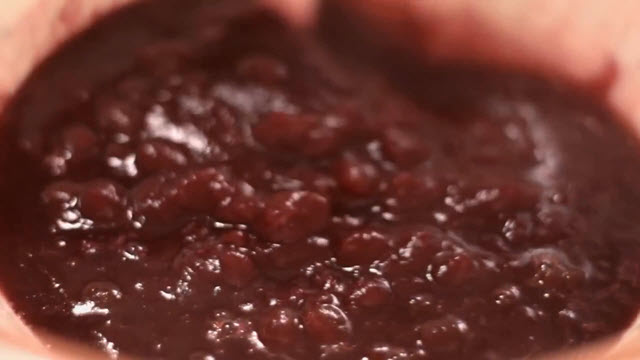
Mash up cranberries to desired consistency (Be aware that cranberries stain everything).
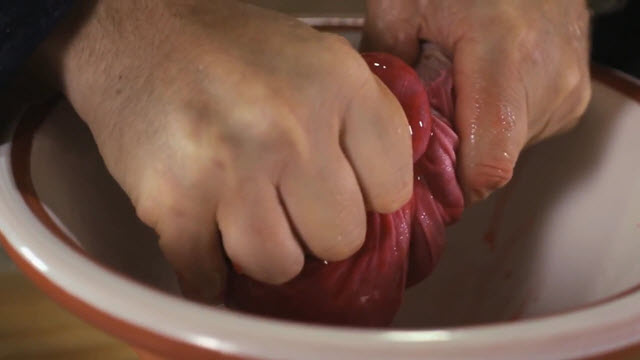
Strain in jelly bag.
Add about the same amount of sugar as you have cranberry sauce to the cranberries and simmer another 10-15 minutes.
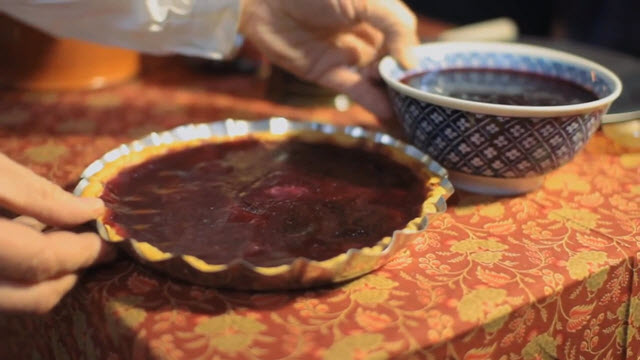
Pour half of cranberries into well buttered tart tin with paste, skimming off any foamy skin on top, and bake at 375 for about 25 minutes.
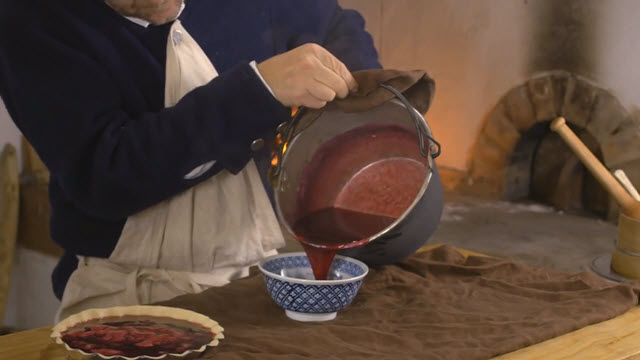
Pour other half into bowl and allow to cool.
Full Transcript:
Now, I’m making a double batch. I’ve got two pounds of cranberries and I’m going to add just enough water to them to cover them. These will need to boil about 15 minutes and as they do, you’ll begin to see the skin begin to break open.
These boiled for their 15 minutes. We’re going to take a masher and mash them up. You do have to remember that if you do cranberries like this, whatever you use to mash them in will permanently be stained a nice cranberry color.
Ok, these are nicely mashed up. If you don’t have a sieve like this, you can use a jelly bag just like we used in the currant jelly video.
Cranberry must have a lot of pectin because it’s already starting to set up.
Pour the contents back into our cooking pot. Let’s sugar it. We need to add about equal quantities, so you’re going to have to sort of guess this unless you measure exactly what you’ve got here, but I think we’ll guess pretty well here. We’re going to stick this back on the fire and let it simmer another 10 or 15 minutes.
Half of this, I’m going to pour into this tart tin with a paste. Any foamy skin that appears on the top of your tart, you can just skim that right off. The other half we’ll pour into our little bowl here. This is our cranberry sauce and it’s going to thicken as it cools. The tart, we’re going to bake at 375 for about 25 minutes. Make sure the tart pan is well buttered so that the crust doesn’t stick. We’re not going to sample these right now. We’re going to wait to put these together into this wonderful holiday feast. I want to thank you for joining us today as we savor the flavors and aromas of the 18th Century.
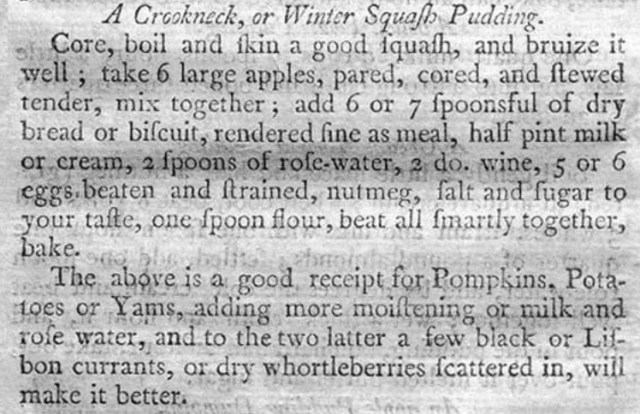
Today we’ll be making a wonderful sweet potato pudding from Amelia Simmons’ 1796 cookbook, American Cookery.
1 ½ pounds Sweet Potatoes (Can substitute Winter Squash, Crookneck Squash, Pumpkin, or any Potatoes)
3 Large Apples
3 ½ tablespoons Breadcrumbs
1 tablespoon flour
1 cup Cream
1 tablespoon Wine
3 Eggs well beaten
¼ cup Sugar
1 tablespoon Nutmeg
Pinch of Salt
¼ cup Dried Black Currants (Can substitute with Zante Currants or Whortleberries)
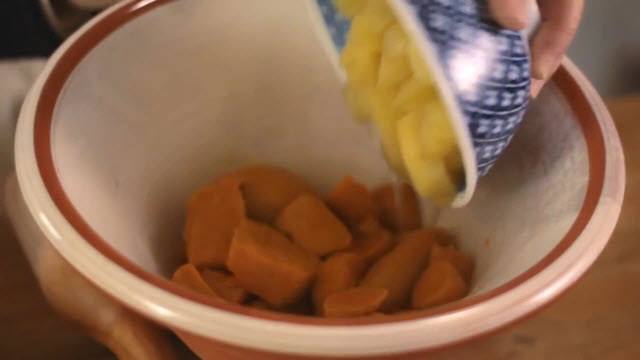
Bake or boil sweet potatoes until soft. Pear, core and chop apples, then boil until soft.
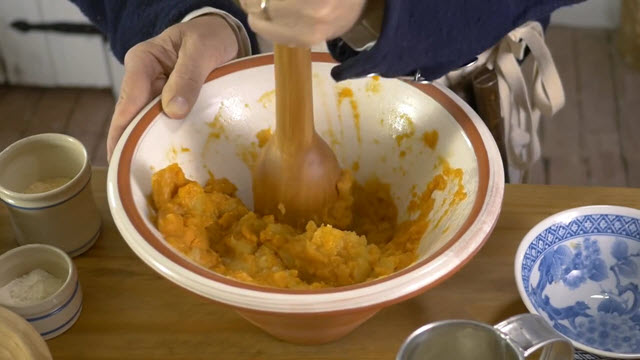
Mash together sweet potatoes and apples until fairly smooth.
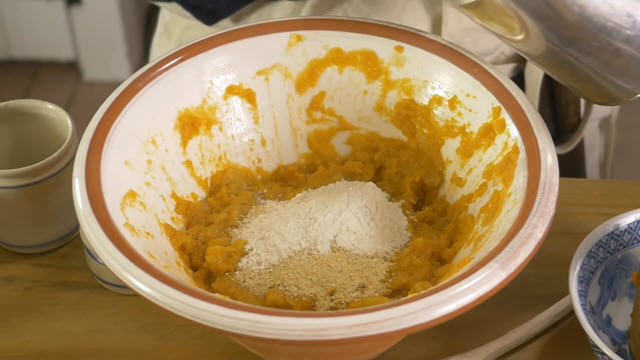
Mix in breadcrumbs, flour, cream, wine, and eggs. Add sugar and spices and mix well. Gently mix in currants.
Place inside of cook pot without the lid. Bake at 325 degrees for about 75-90 minutes.
Transcript of Video:
In our last several episodes, we’ve been cooking dishes most closely associated with the holiday season of Thanksgiving and Christmas here in North America. All these recipes are from Amelia Simmons’ 1796 cookbook, American Cookery. Today we’ll be making a wonderful sweet potato pudding. Thanks for joining us today on 18th Century Cooking with James Townsend and Son.
Amelia Simmons recipe actually calls for a winter squash or crookneck squash, but later on in the recipe, she says that you could substitute sweet potatoes, regular potatoes, or even pumpkin. I’ve chosen sweet potatoes simply because their most commonly associated with Thanksgiving.
To prepare your sweet potatoes, you can either bake them or boil them. If you want to take a shortcut, you can buy canned sweet potatoes. You’ll need about a pound and a half for this recipe. For our recipe, we’re also going to need 3 large apples. You’ll need to pear them, core them and chop them up and then boil them until their soft. Let’s mash these together until their fairly smooth. Our new hardwood masher is perfect for this job. To this, we’ll add 3 ½ tablespoons of breadcrumbs, 1 tablespoon of flour, 1 cup of cream, 1 tablespoon of wine and 3 eggs well beaten. Stir this all together.
I’m going to sweeten this with about ¼ of a cup of sugar. To spice it, I’ve got a tablespoon of nutmeg and a pinch of salt, and we’ll mix this in.
For our final ingredient here, we’re going to add a 1/4 of a cup of black currants. These are dried black currants of the ribes family. She also suggests in her recipe, that you can use zante currants instead, which are like tiny raisins, or possibly dried blueberries, sometimes called whortleberries.
And mix it in.
Today, we’re going to be cooking this in our wonderful little red ware cook pot. These cook pots are available in our catalog. They’re made right here in Indiana and their based off of 18th century paintings. Today we’re going to be cooking without the lid. There’s enough here in this to fill up this pot and possibly even bake a pie from it.
I’ve got this about ¾ of the way full. You want to leave a little bit of room. It’ll try to grow as it cooks and then shrink back down. You’ll want to cook this without the lid on at 325 degrees or so for an hour and 15 minutes, maybe an hour and a half.
So normally about right now, I’d pull out the finished dish and we’d get to taste it, but not this time. This time I’m going to save it for later. We’re going to take all these dishes and put them together into a wonderful holiday feast, so you’re just going to have to wait until the end.
If you’re new to our channel, I really want to welcome you. You can subscribe to our channel, you can check out our website, or request a print catalog. I want to thank you for joining us today as we savor the flavors and the aromas of the 18th Century.
This is a delicious and simple bread stuffing from Amelia Simmons’ 1796 cookbook, American Cookery. Amelia Simmons suggested stuffing the bird before you roast it, but for safety purposes, you should cook this stuffing separately.
1 pound Wheat Breadcrumb
3 Eggs well beaten
3 ounces Suet
Thyme
Marjoram
Salt
Pepper
Sage
½ cup Wine
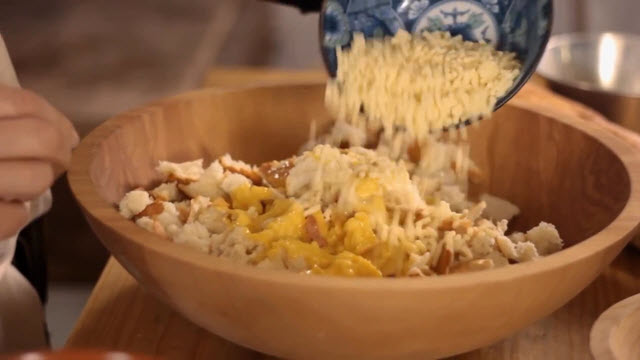
Combine all ingredients, add spices to taste, and mix thoroughly.
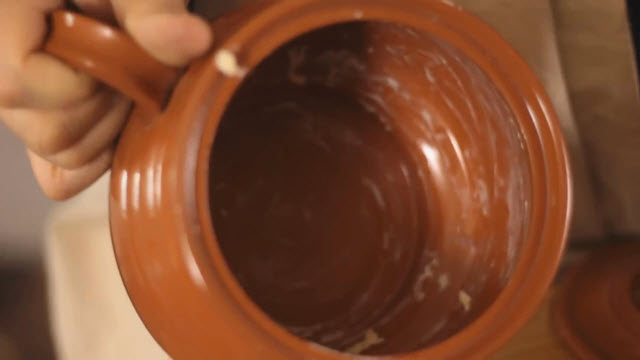
Lightly pack in baking pot that has been well buttered.
Bake with lid on for about 75-90 minutes at 350 degrees.
Transcript of Video:
Well, if you haven’t watched our last episode, make sure to do so. We’re working on a holiday meal series using recipes from Amelia Simmons’ 1796 cookbook, American Cookery. Thanks for joining us today on 18th Century Cooking with James Townsend and Son.
While these birds are finishing cooking, we’re going to be working on the stuffing. Amelia Simmons suggested stuffing the bird before you roast it, but for safety purposes, we’re going to be cooking this stuffing separately. For this recipe, we need 1 pound of wheat bread crumb, 3 eggs well beaten, along with 3 ounces of suet. Here I’m using a Atora suet, about a half a box. For spices, we’ll use thyme, marjoram, salt and pepper, and we’re adding a little sage. And last, I’ve got a gill of wine, which is about half a cup.
This is such a simple recipe. All we really need to do is combine these ingredients and mix them up and then toss them in our pan. Let’s get these all mixed in.
There we are.
We just want to get all our ingredients nice and mixed up. The pot here has already been well buttered. You don’t want to pack it too tightly, just a light pack. Pack this in nicely then we’re going to bake this with the lid on. We’re going to bake this about an hour and a half or an hour and 15 minutes at 350 degrees.
There it is, our bread pudding. It looks wonderful, but I’m not going to sample it yet. You’re going to have to wait until we put this whole meal together. We’re going to have to wait till we put this whole meal together.

 Today we’re making Amelia Simmons’ tasty Indian pudding from her 1796 cookbook, American Cookery.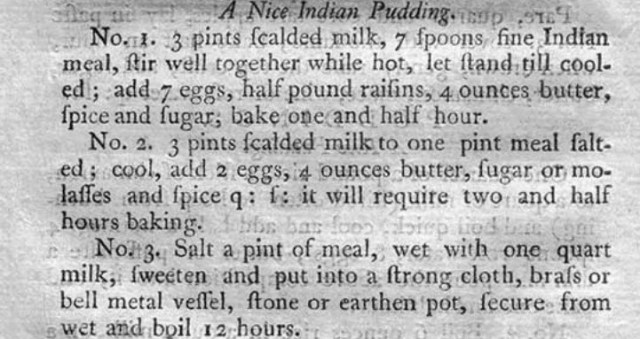
 Once simmering, add cornmeal and continue stirring and cooking until it thickens. Remove from heat and allow to cool just enough that it does not cook the egg when added. When cooled enough, add egg, butter, spices, and molasses and stir until well mixed and the butter is melted.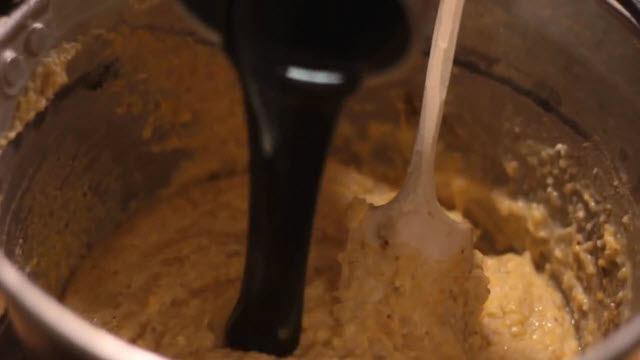


 Combine all mixtures together and stir very well. You will end up with a very stick batter.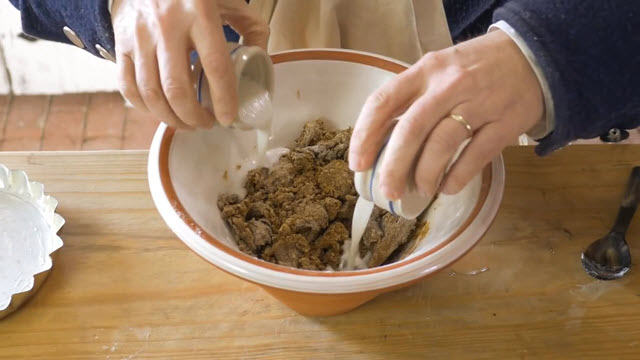
 Bake at 400 degrees for about 15 minutes.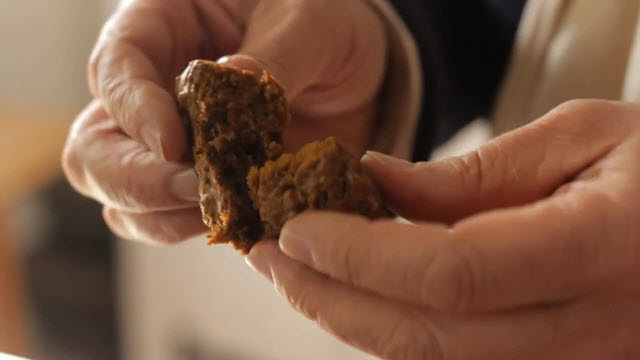

 Dissolve pearl ash into sour milk then mix into other ingredients. Knead for 5-10 minutes adding flour as needed.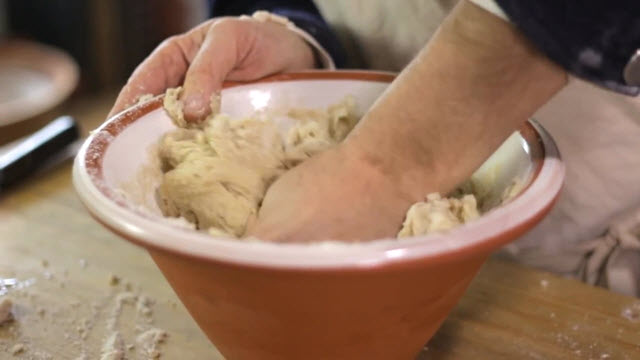


 Peal and mash then add milk and
  Next, add eggs, and molasses.
  Finally, mix in spices and pour into

 Today’s recipe is for what was call American potash cake.
 Dissolve pearl ash completely in water and add to milk. Quickly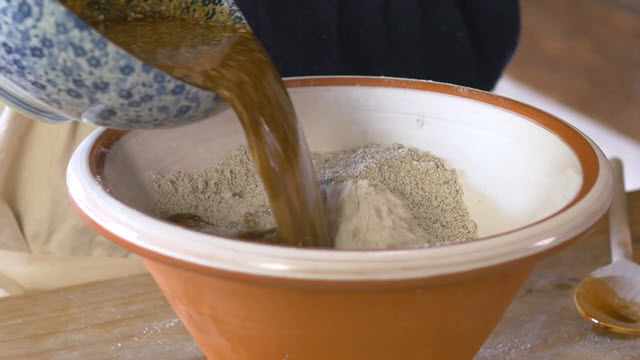


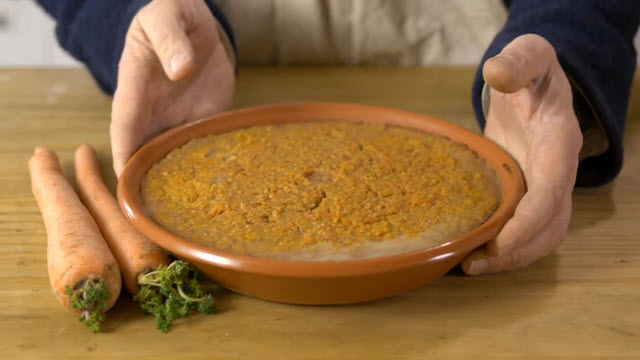 Today’s recipe, a 17th century carrot pudding, comes from The Compleat Cook by Rebecca Price.


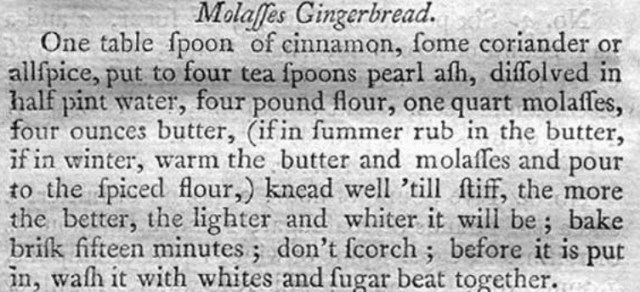

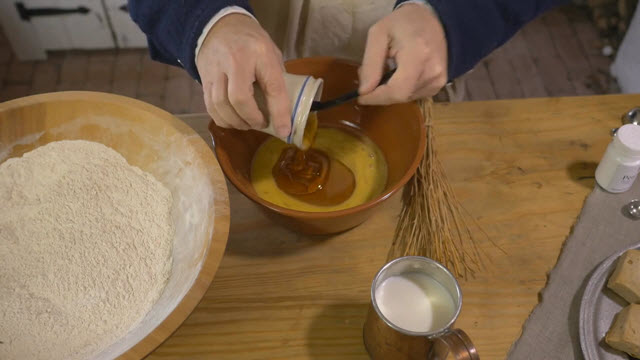 Add pearl ash to the milk and dissolve completely. Mix milk with egg mixture, and then add everything to the dry ingredients.



 Add just enough water to cranberries in cooking pot to cover and boil about 15 minutes until skins break open.



 Gently mix in currants.

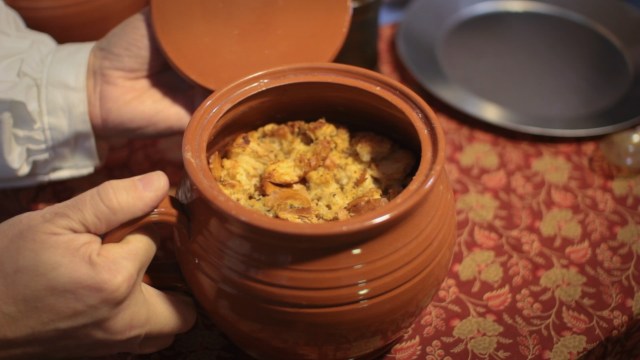 This is a delicious and simple bread stuffing from Amelia Simmons’ 1796 cookbook, American Cookery. Amelia Simmons suggested stuffing the bird before you roast it, but for safety purposes, you should cook this stuffing separately.


 Savoring the Past